Writing · Book in progress · Unfinished work
Around the World in 80 Beds
What I Learned from Sleeping My Way across Cultures and Countries between the Sheets of Strangers
By Keren ThrelfallBegun 202221 min read
Eight passages from a memoir in progress about home, hospitality and the houses of strangers. This is unfinished work — a manuscript still being written, shared here as it stands.
Between the Sheets of Strangers
“… to find a land more kind than home, more large than earth.”— Thomas Wolfe, You Can’t Go Home Again
To sleep between a stranger’s sheets. To drift off facing the books they judged worthy of the nightstand. To clear a space in someone’s drawer and lay your underwear down beside theirs, and to learn, by walking it, the path their body takes each morning through the most intimate space they own — their home. It offers at least the illusion that you are no longer strangers: that you know them by the scattered artifacts of who they are.
You learn a person by their pillows, whether they sleep on one or on four. By which side of the bed has the lamp and the reading glasses. By the soap, and by the smell the soap leaves on towels that are not yours and are, for these weeks, yours. By the drawer that sticks. By the one good knife. By what has been cleared away for your coming, and what they did not think to hide.
The illusion is not unique to me. Nurses know it, and lawyers, birth workers, housekeepers, the people who tend the dying — anyone whose work admits them to the private rooms and daily habits of someone else. Sometimes the familiarity runs only one way. Sometimes it becomes an unexpected road to a lifelong friendship. I have been on both sides of it. A housekeeper who came with a house once learned how to sort my children’s clothes and where the trash sat beside the toilet, and grew fond of us by way of our laundry. It is hard to fold someone’s underwear without feeling that you know them.
I did not set out to collect other people’s beds. For more than a decade I have traveled by home exchange — my house for yours — as a mother of four, beginning without the money such travel is presumed to require.1 I took what I had mastered as a coupon-clipper and turned it on the world. Not every exchange has been someone’s own bedroom. Some houses came with a locked closet, a sealed-off room, a life put carefully out of reach. Some were only furnished shells, with nothing in them to know anyone by. But I have also unpacked my suitcase beside a host’s sacred garments, left folded in the drawer. I have stayed among a former government man’s awards and memorabilia, left out in the open for any guest to read, and I still wonder why.
A nightstand does not know it is being watched. That is exactly why it tells the truth. Habitation is a form of argument, made without rehearsal, and to sleep inside someone else’s is to be handed the whole case at once.
I am changing the name of every person whose home I slept in. The beds I am leaving as they were.
The Artifacts of a Life
“… you’ll miss the person you are now at this time and this place …”— Azar Nafisi, Reading Lolita in Tehran
It is late 2022, and I am rationing out the last morsels of what feels like home. My bottle of oud — the first and only fragrance that has never troubled my allergies — is down to its last few drops.2 I tip it against my wrist and it gives up almost nothing: a dark sweetness, smoke and wood, the inside of a room I cannot go back to. The Advil bottle, lettered in Arabic calligraphy, is one more relic proving that such forays from my passport country truly happened.
I wonder when the red string of my eye-of-protection bracelet will fray, and whether I will be able to go back to Mexico for another. To me it is no talisman. It is a relic of who I was when I bought the first one in Peña de Bernal: a mother of four small children, staying in a house that came with a car at no extra cost, who thought nothing of driving for hours into another state to stand beneath one of the largest monoliths in the world.3
Azar Nafisi, in her memoir of reading in Tehran, describes the strange feeling that comes just before leaving a place: that you will miss the people you love there, and also “the person you are now.” I come back to that sentence because it names what a suitcase cannot hold. I do not miss Peña de Bernal the way one misses a town. I miss the mother of four who drove there without a second thought. The bracelet is the only part of her that came home with me.
Oud can be bought online. A seller on Etsy makes bracelets very like the first. As objects, they can be had again. What I am afraid of losing is the haggling over a bottle of oud, even in a gleaming mall, and the instant my eye first caught the thin rainbow beading of an ojo de venado — and the thrill of hearing that in pesos it cost less than a dollar.4
Because that is how they become the artifacts of a life. To an anthropologist an artifact is an object that carries the logic of the people who made it. To an archivist it is a trace. To a court it is an exhibit. Mine are all three, and none of them is for sale.
As I write this, the zeal is beginning to ebb. It has been too long since my soul last tasted the heightened sensation that what feels like home brings to me. Because for me, home is the smell of jet fuel. It is being in flight: the hurry that sweeps my body and my luggage through security, and then the hollow way time passes when only a flight is waiting. It is the first smell of an arrival — the one you will fasten to every later memory of a once-foreign land — and the way an unknown language first shouts at you, then swallows you whole, and at last becomes a kind of music playing behind everything.
What is for some a traumatic rupture is, for others, a rupture from the familiar that works as a rapture — a return to ourselves, seen from a new side in the novelty.
Quito, Midnight
“If I’m an advocate for anything, it’s to move.”— Anthony Bourdain
We flew into Quito at midnight. The suitcases were piled in the back of the car, and my three children — five, three and one — were piled on my lap. In that cramped, airless sedan I could finally breathe: mountain air rolling down off the Andes, threaded with the smoke of cooking fires and warming fires, and a drift of diesel as we passed through villages that were only shadows on either side of the road. The window was cracked just far enough for the night to come in cold and sharp, while my thirteen-month-old breathed hot and damp against my breast, nursed to sleep at last after a long day crossing the dark below.
To be in flight
was, to me,
to feel at
home
in the world.
Few things replace what traveling with a child can teach. More than seeing the world through a child’s eyes, it is seeing a culture through how it sees children. In Andean Ecuador we were hurried to the front of every line. My son was scooped up by any woman of childbearing years, past or present, and carried off into the back of a restaurant to be shown around — “we will watch the baby while you eat.”
A decade later that same son plays video games online with a friend he made in Dubai, and during Ramadan we know the hours: the fast until iftar brings his friend’s evenings into our afternoon. My children were the invitation. Doors opened for them that would never have opened for me alone.
But that first night the road only kept rising. The car climbed and the air thinned and sweetened, and the baby slept, heavy and warm, his breath slowing against me. We were ascending into an altitude I had never known.5
I had forgotten to remember that altitude sickness might be one more new experience to prepare my children for.
Harlem, the First Night
“… even though I didn’t grow up in Harlem, it has always felt like home.”— Geoffrey Canada
It was unexpectedly warm as I left Philadelphia. Sweat crept between my palms and the steering wheel of the minivan — not from the weather, but from leaving the known and driving toward the not yet known. The balm in the air felt like a strange burst of spring inside a harsh February: a week of invasion and inflation, of a whole country worn thin.
The month before, I had sorted, given away and boxed the contents of a massive farmhouse. Now my entire life was in two suitcases. When the map routed me past the Lincoln Tunnel, the only door into Manhattan I knew, I found my hand rummaging through the console for toll money without my having told it to.
We were displaced. We were between houses, with nowhere to go — except a stranger’s brownstone in Upper Manhattan, above 110th Street, the old line at the top of Central Park that has sorted the island’s addresses into those that carry one kind of story and those that carry another. Mine was a displacement of privilege, and I knew it. I had spent that semester reading about people whose displacement was not.
At once I was a West Virginia coal miner’s daughter and a Harvard graduate student, driving into a place whose name has filled books, films, music and history: Harlem.6 In the end there were no tolls, or none taken by a human hand. A camera blinked at my license plate, and that was that. I worried that one look at our minivan — especially when the doors slid open and the crumbs fell out — would give us away as people who did not belong here.
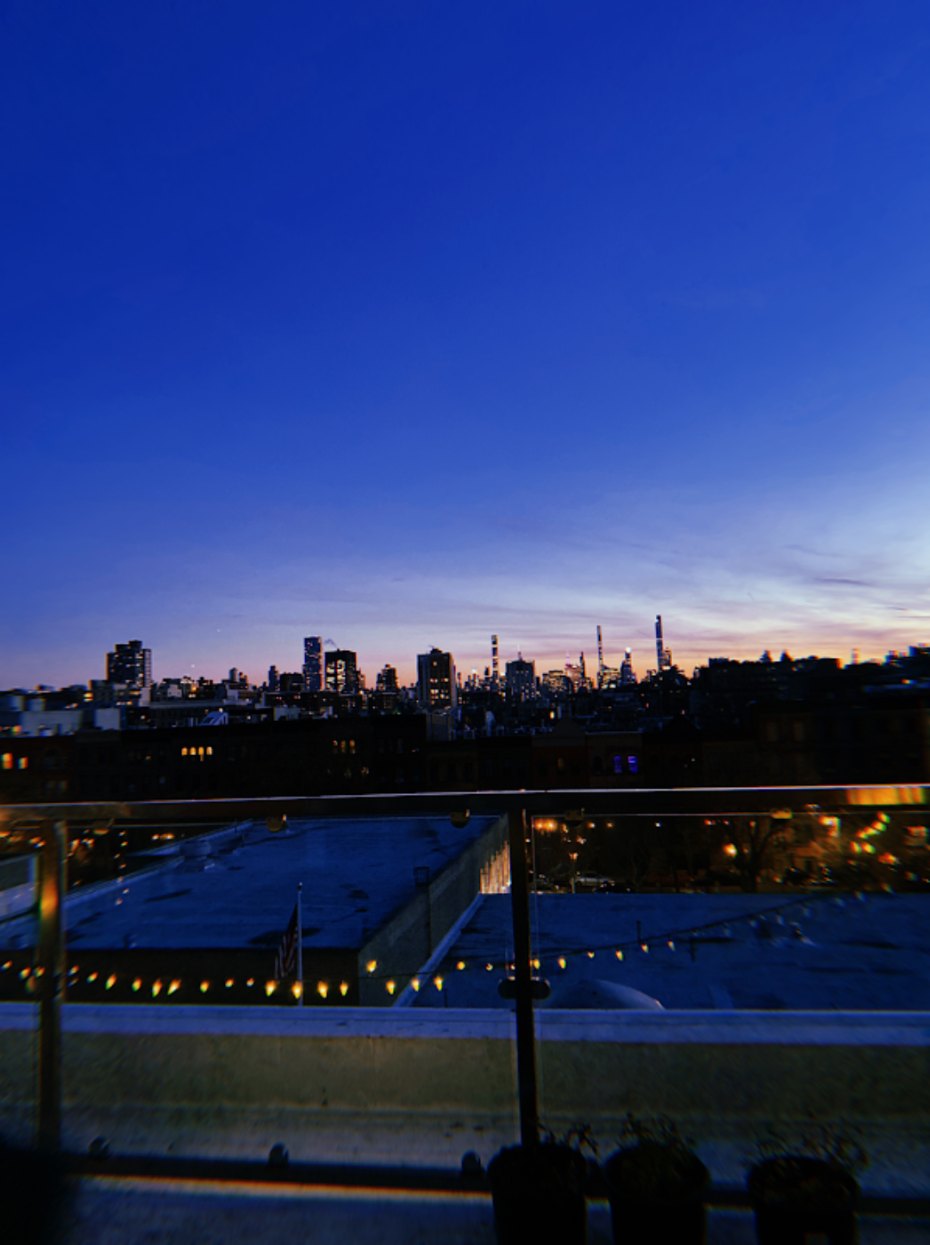
Five flights of stairs left me breathless, and the view from the top balcony took what breath remained: Manhattan, laid out as far as the air would let me see. The buildings were lit blue and yellow for Ukraine. The invasion was not yet a week old, and I had not gone to sleep before three in the morning since the night before it began.7
“Harlem is really, for African-Americans, sort of the mecca.”— Geoffrey Canada
There was a Whole Foods three blocks away. When a Whole Foods is three blocks away, you know this may be a different Harlem from the one Zora Neale Hurston and Langston Hughes wrote about.
My host was a painter, and I sat for my evening class in her studio at the top of the house. One wall was a grid of screws, perfectly spaced, waiting for canvases. On the others hung charcoal sketches of women clutching their children, of female bodies curled into themselves. I felt the grief in them, and the ache of mothering in a broken world, before I knew anything about her. I felt kinship with a stranger I had never met, whose studio I was sitting in and whose bed I would slip into hours later — not to sleep, but to rest a weary body while I read the news.
I was electrically alive, and exhausted. For that night the brownstone felt as though it could be home — for a week, a month, for years if it came to that.
I did not yet know how much of myself I would spend, in the days that followed, scanning every street for what might be coming.
Below Ground
One of the great joys of travel is learning a place on foot and by its public transit. You see things in that slowness, pressed in among strangers, that stay invisible to an outsider in a car.
I left a West Virginia town of fewer than three thousand people when I finished high school, with no idea what public transit was. I learned it in Berlin, which set the bar high. So in New York I gave myself a rule: for two weeks, nothing but my feet and the subway. I bought a seven-day pass for thirty-three dollars and meant to get every cent out of it.
Naturally I decided the best way to learn the lines was alone, at night. I walked fast up to 125th Street, to save time and to stay warm. At first I was the only woman in the car. As the train ran south, each stop changed the faces around me, until I was no longer the only one who would have checked the box I check.
A few days later I took three of my children the length of the island, forty-five minutes to the Battery and the ferry to the Statue of Liberty. A man boarded with us whose mind had been overtaken by some substance. He looked into my eyes and shouted terrible things. Later each of my children would say that he had been looking straight into theirs. Some of what he said was true. He was angry at how Black people had been treated, at a system that catered to people who look like me and had hurt people like him. I was silent, more from shock than from anything else.
My daughter had brought her crochet. I could hear her hook picking up speed with every shout.
At the next stop a woman got on and sat down beside her. She took off her hat and showed my daughter how she had made it, stitch by stitch, and the whole car let out its breath. In a single ride my daughter had met both ends of what the subway can be.
*How do I
explain
to my children
that riding the subway
with men
addicted or drunk,
begging or shouting,
at us —
at anyone —
is normal?*
*I don’t want
to live
in a world
where
we teach
our children
it is normal
to look away
just to stay
safe.*
I rode in cars with no room to stand and in cars where I was alone. I rode in cars thick enough with smoke to give a stranger a second-hand high, and I watched a man convulse in a corner seat. I learned to look down in certain stations. I learned which exits were best. When we moved a few stops north to Washington Heights, I stepped out on a warm Sunday night into dancing, music and Spanish spilling down every block, and I learned to pull my hood up over my blonde hair.
And the more I rode, the more often I heard the same announcement over the speakers, delivered in the flat voice kept for delays. The train has struck a passenger.
Another delay, I thought. Another inconvenience.
Until I understood what the words meant. Trains do not leave their tracks to go looking for people.
Four Weeks in Dubai
I am writing this on the day of another mass shooting in America.
I had not known how heavy it was — the daily possibility of the next one — until I had been in Dubai for a few days and felt my shoulders come down. In our neighborhood no one locked a door at night. Only there did I see how much of myself I had been spending in New York on watching: like the frog in the story, who never feels the water warming.
I had come for a reason with an expiration date. Expo 2020 — still called that, though the pandemic had pushed it back and the year was now 2022 — was in its last weeks.8 And I had come on a dare I had made with myself. A gamified challenge will get me every time, if it has the right hook: could I take a family of six to Dubai and back, and house us for nearly seven weeks between New York and the Gulf, for under a thousand dollars?
In case you are left wondering, the answer is yes.
The Expo had a game of its own. Fill a yellow paper passport with a hundred pavilion stamps and you were given a white one. It was game on. I spent whole nights crossing the world on foot, from one small country to the next.
The camels came later — seen in the distance from the driver’s seat, a woman at the wheel with her four children in the back, in a country the old stereotypes insist would never let her drive. And the mint lemonade, on every menu in the Emirates. And the majlis, the rooms where women gather apart, where I was asked to explain home exchange, and Mexico, and America.9 There is no hospitality like Arab hospitality. “It’s because of Islam,” I was told. I have photographs from those rooms that I cannot show anyone.
We landed a little after midnight. The lines were long. Standing in them, I thought about the first tickets I had nearly bought, the cheapest ones, on Aeroflot — routed through Moscow, in March of 2022.
Where Is Home?
“… this craving for anchorage, for a rock, a center …”— Michael D. Jackson, Excursions
It is loud and crowded, and I want only what I think will make this place taste like home.
Shrimp and grits.
It has been one month since I touched down on American soil after nearly a month in Dubai, and I am ordering the dish that is supposed to mean I belong here.
I have birthed four children in this land of red Carolina clay. I have come to love pimiento cheese, and nearness to the coast. But I feel disoriented and out of sorts, as if I don’t really belong here — as if shrimp and grits could satiate the ache in my heart that I have come to know as grief. Grief, even, so delicately applied: for a place that was only ever temporary, and new.
Here, in South Carolina, I have met men whose parents farmed this soil as sharecroppers. I have visited state parks that bear witness to a plantation’s economic success while leaving the rest of the story between the lines. I have read the roadside signs about the lynchings that spilled the blood of Black men into this same red ground.
Something in Dubai felt like home, just as something in Mexico, Germany, Guatemala and Italy has.
But where is home?
Is it to be found in my insatiable thirst for a few sips of the mint lemonade that was ubiquitous on any menu in the Emirates?
Is it in our forgotten family ritual of making apple butter together, amidst the hillside orchards of my grandparents’ West Virginia home — before that, my mother’s grandparents’ home?
Is it a walk across the bridge to Marietta, Ohio — where my mother gave birth to me, but then drove forty-five minutes back to the smaller village, where the house that first greeted me as a newborn was settled on eleven acres even further out?10
Or was it that feeling of familiarity when I lived in Germany, knowing that somewhere nearby some young man, some young girl, some relatives of mine had made their way to Bremen, and embarked from its ports?11
Our brains are still primed for danger, and they simplify. It would not have served us to dwell on the meaning of home when running there and shutting the door kept us from becoming a meal for the beast behind us. So a word becomes a concept, becomes an identity, becomes an anti-identity. The meanings we hang on it are folklore — the loom on which a culture weaves what it knows. We spend the best hours of our days away from home, working to pay for it, believing that if we ever find time to think about what it means, home is where we will do the thinking.
For me, for now, home is still a space and a meaning that eludes me — perhaps because I keep thinking I will find it in some place, or in one place.
Almost Home, West Virginia
“For now we see through a glass, darkly.”— 1 Corinthians 13:12, King James Version
I think I found a little bit of home in an obituary — my grandmother’s.
Nearly anyone, anywhere in the world, who hears that someone is from West Virginia already knows the way there, because a song has told them.12
I stumbled on it. I was looking for my grandfather’s dates, and for the family history my mother had made, and the search gave me this instead. My grandmother died ancient enough never to have had an email address, and young enough for her obituary to be catalogued in a digital world she never knew.
There are ways in which a heart can break twice, or more. I lost my grandmother before I was old enough to see that I had lost more than warmth and comfort — that going to see her had been how I turned myself toward home.
Her coffee table gave me endless issues of National Geographic and of her beloved state’s monthly magazine, Wonderful West Virginia. Her dining table gave me proper etiquette, West Virginia’s heartiest meals, and Sunday afternoon tea parties — a ritual she carried home from her one trip across the Atlantic, not one handed down from our British ancestors. The obituary handed me back a thread I had let go slack: her years at West Virginia’s folk festivals, passing on Appalachia’s vanishing art of spinning wool, on the road with her wheel through West Virginia, Ohio, Pennsylvania and as far as Washington, D.C.13
She lived on a hillside in Glenville, West Virginia, with a vineyard and an orchard, where we sometimes gathered by the dozens to spend a whole day making apple butter over an open kettle, with a penny thrown in — for good luck or for good flavor, one of the two.14 My sister and I roamed the afternoons, sneaking raspberries not quite ripe, slipping a strawberry out from under the nets my grandfather had so carefully pinned down. She discovered that if she gripped the electric fence with both arms and kept both feet on the ground, her veins would throb with the current, but only the person holding on to the end of her would feel the shock.
Two bedroom closets were joined by a tunnel bored through the attic, and there, under the eaves, she kept her greatest treasure: back issues of National Geographic reaching past the year I was born. I chased my cousins through that tunnel while the adults sat long hours at the table below. And I hid in those eaves, in the dust and the dark, and dissolved into the photographs of everywhere else.
As a child I watched her bathe my great-grandmother. Always she filled the sink with hot water first and stood a bottle of lotion in it, the date of its opening written on the side, and waited for it to warm.
At seventeen — my father dying of cancer, my mother stretched between his care and her teaching — I was sent to live with my grandmother, to feed her and to bathe her. The spinning wheel sat empty, through the hallway and across the living room.
I was the one filling the sink now. I pulled up the silver stopper and checked that the lotion was not too warm, and not too cold.
I remember seeing my grandmother’s naked body for the first time — probably the first time I had seen anyone in my family so. I tried to turn my eyes from it, and from the shame that burned in me: a shame shaped by the purity culture of my religious world, one far more conservative than hers.
She showed none. No embarrassment that I was now the caregiver, that mine were the hands rubbing lotion into her skin. She joked about how weight shifts here and there — that it is something you learn with age. She was right. I think of it every season, when my clothes fit my own changing body a little differently than they did the year before.
Even when I was washing her dishes, washing her body, I could feel her lifelong caregiving turned toward me.
On the last day I saw her alive, I carried the news of a third child in my womb. I whispered my goodbyes in her ear, then slipped out quietly while my mother and my aunt held her close.
It was not homemaking that kept her to home and hearth. It was caregiving. I saw her all those years as the consummate homemaker, and I did not yet see myself in her, because I could not yet see myself.
In my late thirties I found that she had run more threads from me to her than I had ever seen in the yarn basket. I am still following them. One of them leads to a miner’s daughter, a stranger to blue water.
Still to Come
The scorpion on my pillow. Canada’s ice-wine vineyards, and the Mexico I found in them. An invitation to an abuela’s pozole. The year we tried to make a home in the shadow of a smoking volcano, and the world as we knew it blew up. The night the boat stood still on the lake. Christmas in Belize. Walking home from a Berlin emergency room. My daughter, Pancake.
It is not us that ends here, but this draft.
Notes
1. Organized home exchange began among schoolteachers in the early 1950s, trading houses across borders over the long school holidays; the oldest network, Intervac, dates itself to 1953.
2. Oud is the dark resin an agarwood tree makes in answer to a wound. It has been burned and worn across Arabia and South Asia for centuries.
3. Peña de Bernal, in the Mexican state of Querétaro, is a rock some four hundred meters high. In 2009 UNESCO inscribed it, with the living traditions of the Otomí-Chichimeca people of Tolimán for whom it is sacred, on its list of the Intangible Cultural Heritage of Humanity.
4. Ojo de venado, “deer’s eye”: a dark seed strung on red thread and worn, often by infants, against the evil eye.
5. Quito stands at about 2,850 meters — 9,350 feet — among the highest capital cities in the world. Its old city was one of the first places UNESCO named a World Heritage Site, in 1978.
6. In the 1920s and 1930s, as the Great Migration brought Black southerners north, Harlem became the capital of Black American art and letters: the Harlem Renaissance.
7. Russia’s full-scale invasion of Ukraine began on February 24, 2022. We arrived in Harlem on February 28.
8. Dubai won the right to host the world’s fair in 2013, over Yekaterinburg, Russia. Postponed by the pandemic, Expo 2020 ran from October 1, 2021 to March 31, 2022.
9. Majlis, Arabic for “a place of sitting”: the room in a Gulf home where guests are received, often with separate rooms for men and for women.
10. Marietta, founded in 1788 where the Muskingum River meets the Ohio, was the first permanent American settlement in the Northwest Territory.
11. Between 1830 and 1974 more than seven million emigrants left Europe through the port of Bremerhaven, downriver from Bremen.
12. “Take Me Home, Country Roads,” recorded by John Denver in 1971, is one of West Virginia’s official state songs.
13. Glenville is the home of the West Virginia State Folk Festival, held each June since the 1950s.
14. The coin is an old kettle custom. One West Virginia family recalls a grandmother who “used to put silver dollars in the bottom of the kettle to supposedly keep it from burning”: Ashton Marra, “Butter Up,” Wonderful West Virginia, October 2018 — the same magazine that lay on my grandmother’s coffee table.
Write to the author Responses come to Keren privately by email.
Excerpts from a book in progress; first published here in November 2026.
© Keren Threlfall. To reprint or use this work, write to keren@kerenthrelfall.com.
How to cite this pieceThrelfall, Keren. “Around the World in 80 Beds: What I Learned from Sleeping My Way across Cultures and Countries between the Sheets of Strangers.” kerenthrelfall.com, Begun 2022. https://kerenthrelfall.com/writing/around-the-world-in-80-beds