Writing · Academic paper
Uncovering the Aztec Mundi
How the Frontispiece of Codex Fejérváry-Mayer Shows the Cosmovision and Axis Mundi of the Pre-Conquest Mexica-Aztec and Mesoamericans
By Keren ThrelfallOctober 7, 201940 min read
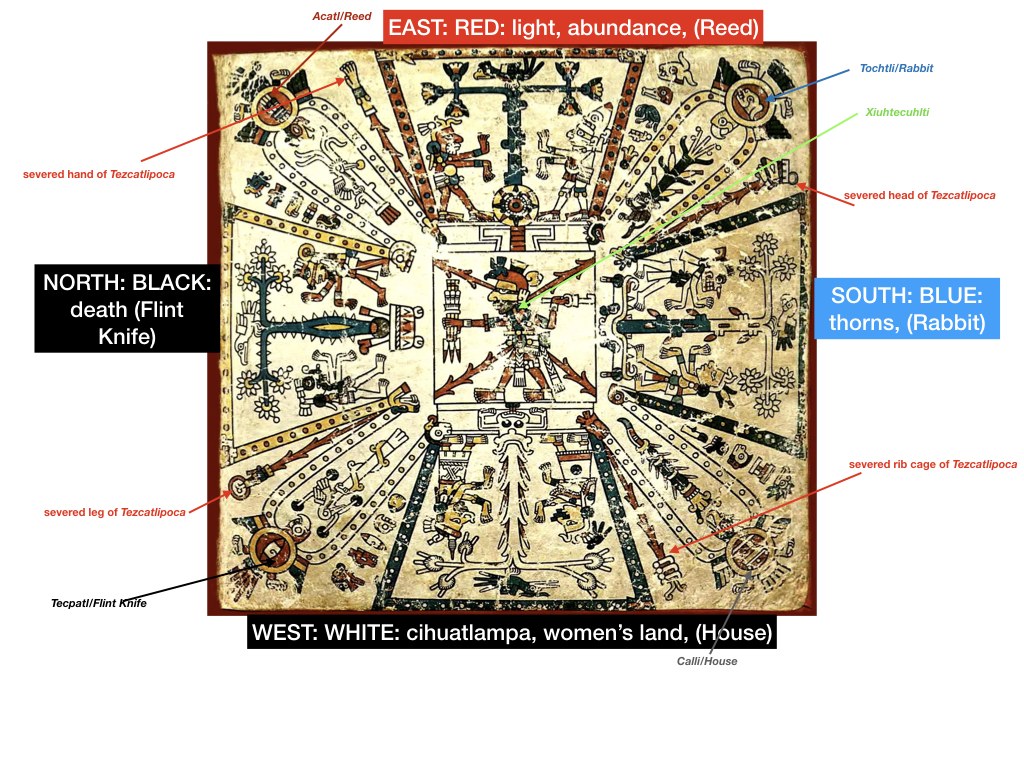
The first question to ask of this image is whether it was made before the Spanish conquest or after it; and the page answers before any scholar does. Nothing on it is written in a Latin alphabet, no European object appears, and none of the faces is drawn in a European manner. The image is pre-conquest, which places it among only about fifteen manuscripts of that age known to survive.1 It comes from the Codex Fejérváry-Mayer, a screenfold of twenty-three pages of painted deerskin, each scarcely wider than an open hand, made somewhere in central or eastern Mexico by people whose names we do not have; the names it carries instead are those of a Hungarian collector and a Liverpool goldsmith.2 It is the first page of that book, and of everything in the codex it is the best known — reproduced in textbooks, on museum walls, on the covers of other people’s studies — and it has earned the attention.
Much of that attention, however, has gone to the page as a design, and it was never only a design; the painter, a tlacuilo trained in what Nahuatl speakers called in tlilli, in tlapalli — the black ink, the red — was not decorating a surface but rather setting down an argument about how the world is built, in a form that a trained reader could consult, count through, and act upon.3 What follows is an attempt to read it in that spirit: slowly, from the center outward and back again, asking of each element what it is doing there.
A Map of What, Exactly?
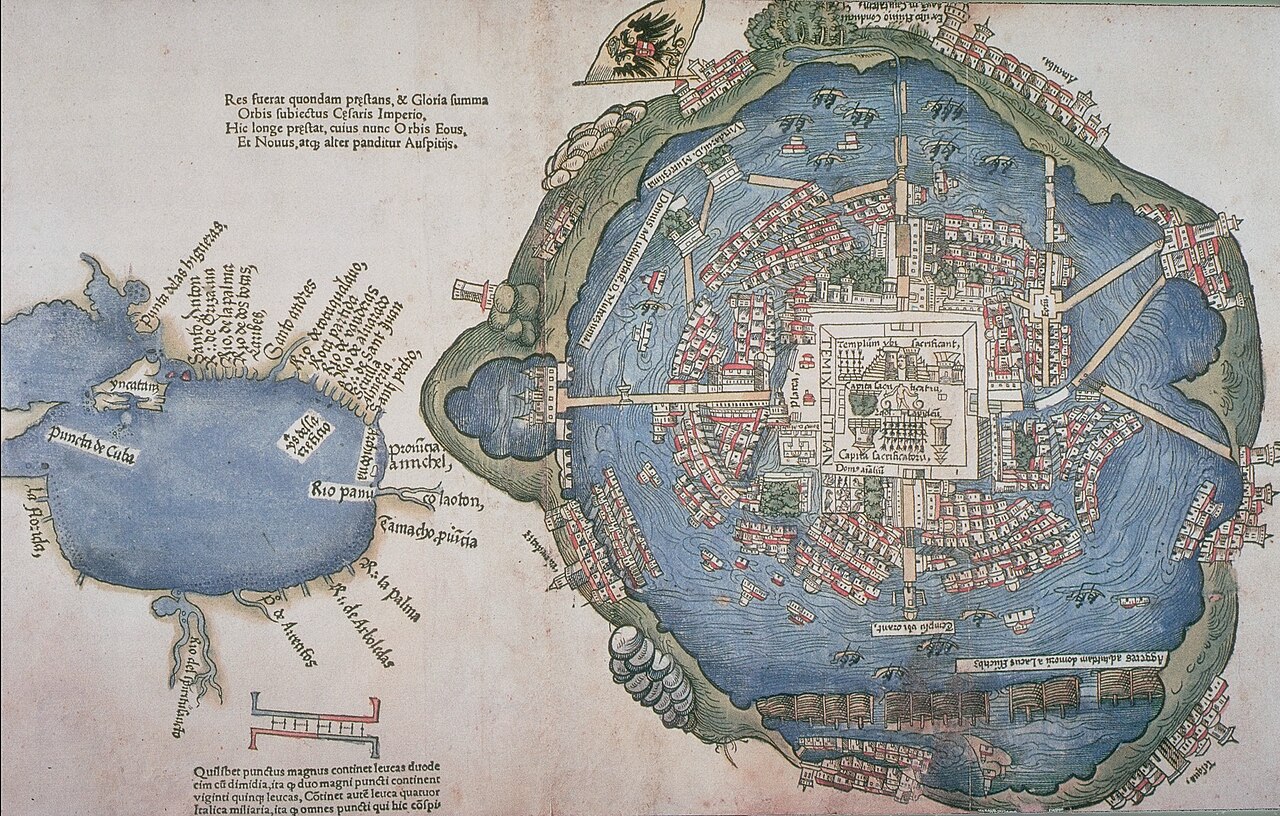
The page resembles two other images, and the resemblance is instructive chiefly for where it fails. One is the map of Tenochtitlan, the great Mexica-Aztec city, printed at Nuremberg in 1524 with the letters of Hernán Cortés: an island city drawn in the round, its causeways running out across the lake and its temple precinct swollen at the center, as though the European engraver could not help but register what the place itself insisted upon. The other is the frontispiece of the post-conquest Codex Mendoza, painted by Indigenous artists some twenty years after the city fell, where crossing bands of water divide Tenochtitlan into four quarters and the center is held by the eagle perched on a nopal cactus.4
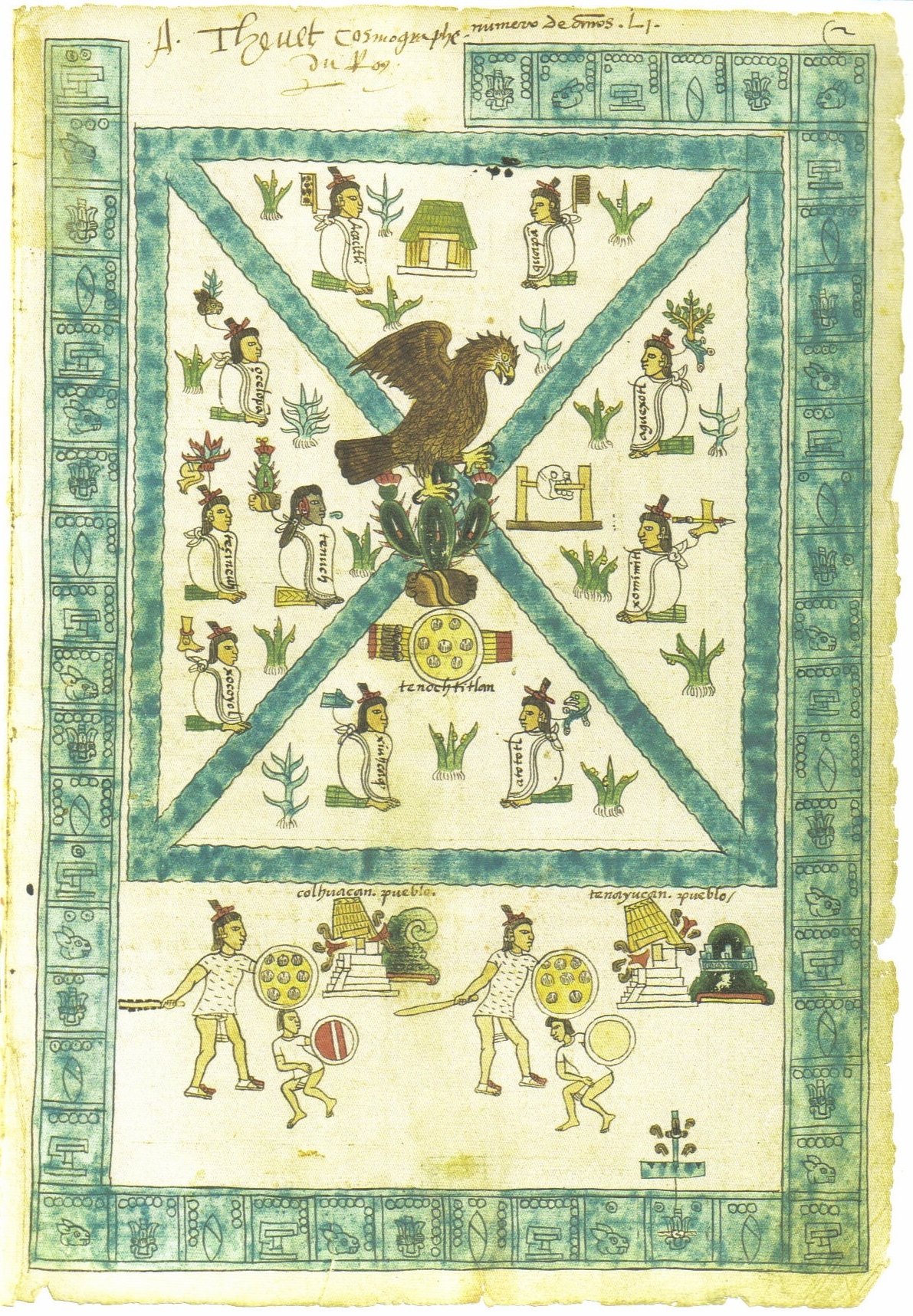
All three are four-part designs organized around a charged middle; the difference lies in what is being mapped. The Nuremberg map sets out a geography, a place one might sail to and seize. The Fejérváry-Mayer frontispiece sets out a cosmovision.5 It shows how its makers and its first readers understood the cosmos and their own place within it — what Western usage would call, more thinly, a worldview. Davíd Carrasco names the image exactly: it is “a cosmogram — a symbolic map of the entire cosmos.”6 It is also, as will become clear, a calendar; and the fact that a single page could be both at once, without strain, is the first thing it has to teach.
The Gift at the Center
The eye goes first to the middle of the page, to what looks like a man in bright regalia, armed and striding. He is no mere man. He is Xiuhtecuhtli, the fire god, the Oldest God — the lord of the hearth, which in a Mesoamerican house burned at the center of the floor, so that every household kept in miniature the arrangement this page draws at the scale of the universe.7 Toward him, or from him, blood runs in four jagged streams, carrying divine energy with it, and each stream ends at a part of a body: “the head, the rib cage, the deflected foot, and the hand.”8 The blood and the body belong to Tezcatlipoca, Lord of the Smoking Mirror. The four streams divide the page into quarters, and the division is the point; it was through this bloody sacrifice, and through the scattering of the god’s body in four parts, that the four directions — east, north, west and south — came into being.
The proposition deserves to be read twice, because it is stranger and more exacting than it first appears. Space itself, on this account, is not a neutral container into which gods and people were afterward placed; it is the residue of a death. To stand anywhere, and to face any direction, is to stand inside a body that was given.
Blood and body together recall the Mesoamerican stories of origin, which tell the same thing in several registers. In one, the present sun rose over Teotihuacan only after a god had thrown himself into the fire to become it, and moved across the sky only after the remaining gods had given their own lives to set it going; in another, the people of this age were made from the bones of the dead of an earlier one, ground to meal and quickened by blood that a god drew from his own body.9 People were made, that is, by the self-sacrifice of the gods, and to keep human life and the cosmos going they owed, in turn, a “blood debt to their deities.”10 The language kept the account openly: one Nahuatl word for sacrificial offering, nextlahualli, means the payment of a debt.11 The life force released by the divine sacrifice let people be created, crops ripen, animals quicken, and the calendar itself keep time.12
It is worth pausing over what these stories say, and over what they decline to say. Neither describes a creation by command, in which a god speaks and a world appears at no cost to the speaker; in both, something living is used up, and the world that results is made out of what was spent. A reader formed by Genesis, as I was, will feel the difference at once, and ought to ask what follows from it: what a people owes to a creator who was diminished by creating; whether a debt of that kind can ever be discharged, or only serviced; and who, in practice, was made to pay it — since the stories speak of gods who gave themselves, while the record of the temples speaks largely of captives who were given.
There are questions of evidence as well, and they should travel with us through the rest of the page. Both stories reach us through alphabetic texts set down after the conquest, by Nahua scribes working with friars or for them, whereas the page was painted before any of that; how far may the later words be used to read the earlier picture? And if the codex was made outside the Valley of Mexico, by painters who may not have spoken Nahuatl at all, how much of what we call Aztec are we carrying into it, and how much was truly shared across Mesoamerica?13
The Aztecs and their neighbors “viewed their existence as a gift from the cosmos.”14 The gift was not altruism. In a gift economy of this kind, Carrasco told our class, “there is always an ‘obligation,’ or a force set loose to get a gift back.”15 An anthropologist will hear Marcel Mauss in that sentence, and rightly: the gift that arrives looking free and turns out to carry within it the obligation to receive and the obligation to return.16 But the cosmogram presses the insight further than Mauss’s exchanges of blankets, shells and feasts ever had to go, for here the first gift was life, the givers were gods, and the thing given could be returned only in kind. Reciprocity was built into the making of the world, and a debt was always outstanding. At the heart of this cosmovision, then, lay the conviction that the gods had given life, energy and abundance by giving themselves — and that human life and the balance of the world could be sustained only by paying the gift back, again and again.
Debt and Sacrifice, Twice Translated
Both of the words on which this reading turns arrive in English already heavy with another history, and it is worth unloading them before going further. Sacrifice comes from the Latin for making a thing sacred, but in ordinary Western speech it has come to mean chiefly loss: what one gives up, goes without, lays down. Debt, for its part, has been tangled with guilt for as long as the Christian West has prayed; the petition that many of us learned as “forgive us our debts” uses the vocabulary of the ledger for the condition of the soul, and Nietzsche built a whole genealogy of morals on the observation that German has one root for owing and for being at fault.17 In the theology that grew from that tangle, and that Anselm gave its classic form, the debt is juridical. It was incurred by a transgression; it is owed by the guilty; it is too great for the debtor ever to pay; and it is therefore paid by another, once and for all, after which the altar may be cleared and the account closed.18
Almost none of this holds for the page before us. The debt it draws was not incurred by any fault, since there is no fall in these stories and no first disobedience; people owe because they are alive, in the way that anything which eats owes its life to what it has eaten. Nahuatl called the common people macehualtin, which Miguel León-Portilla glossed as those who were merited — brought into being through the penance of a god — so that to be human was, by definition, to be the outcome of someone else’s payment.19 Nor could such a debt be settled and set aside. It was not a sentence to be served but rather something nearer to a metabolism: the gods give their substance, the earth yields maize, people eat, and what they have taken must go back into the round or the round will stop. The idiom is alimentary where the Western one is legal; the governing question is not who is guilty but who has been fed, and who is hungry now.20
Two consequences follow, and both cut against what a Western reader expects to find. The first is that payment was, before anything else, ordinary and one’s own. Priests, rulers and householders drew blood from their own ears, tongues and limbs with maguey thorns, and did so far more often than anyone was led up the steps of a temple; the spectacular offering stood at the far end of a practice that began in private, with one’s own body.21 The second is that the person who died on the summit was not understood merely as a payment handed over. In the great festivals the victim was an ixiptla, the living image of the god, dressed, addressed and honored as that god for days or months beforehand, so that what the rite repeated was not a human being given to a deity but rather the deity dying again, as at the beginning.22
None of this dissolves the moral question, to which I return at the end; a captive robed as a god is still a captive. But it does change what we are entitled to say we have seen. The friars who first described these rites were appalled by them, and their horror was sharpened by recognition, for they had come from celebrating a sacrifice of their own, in which a god’s body was given and eaten, and they found among the Mexica a ceremony whose very name meant that the god is eaten.23 What separated the two altars was not that one people believed in redemptive blood and the other did not. It was rather that one had declared the account closed, and the other believed it could never be.
Four Quarters and a Count of Days
Most of the picture is enclosed by a thick band studded with dots, which bends into the shape of a Maltese cross with four additional lobes between its arms.24 Inga Clendinnen reads the band as the count of the sacred round: 260 dots for its 260 days, with the twenty day signs set in to mark off each interval of thirteen.25 The border, in other words, is not a frame around the picture but rather a path through it; a reader could set a finger on the first day and travel the whole circuit of the world, quarter by quarter, arriving after 260 days at the place of beginning.
Mesoamericans kept two calendars side by side. The count of 260 days — twenty named signs turning against thirteen numbers — governed fate, divination and the naming of children; the count of 365 followed the sun and the seasons through eighteen months of twenty days and five days left over, which were thought unlucky. The two fell back into step only once in every fifty-two years, and at that juncture, when there was no assurance that time would consent to continue, every fire in the land was put out and the people waited in the dark for the New Fire Ceremony to renew the sun.26 It is worth noticing whose ceremony that was. The god of fire stands at the center of this page, and what the page draws around him — the days, the years, the quarters of the world — is precisely what the new flame was kindled to keep.
The band divides the page a second time. Each arm of the cross stands for one direction and carries that direction’s color and its burden of meaning: east, at the top, where the sun rises, the place of light and abundance; north, the country of flint and of death; west, cihuatlampa, the women’s land, where the sun goes down; south, the place of thorns.27 That east and not north should stand at the top is no accident, and an English speaker has the evidence in her own mouth, since to orient a map once meant to turn it toward the sunrise. Each arm also holds a cosmic tree with a bird at its crown, a pair of deities flanking the tree, and a further sign beneath it. The trees are the posts of the world, rooted below the earth and crowned in the sky, and Alfredo López Austin has taught a generation of readers to see them as hollow — conduits through which the forces of the upper and lower worlds, and time itself, flow out onto the surface where people live.28 The deities come in four pairs, eight in all; counted together with the god at the center they make nine, and commentators since Eduard Seler have recognized in them the nine Lords of the Night, who governed the hours of darkness in rotation.29
At the tips of the lobes sit four further signs: Reed, Flint Knife, House and Rabbit. These are the year-bearers, the only four of the twenty day signs on which a year could begin and from which, therefore, a year could take its name. Each belonged to a direction — Reed to the east, Flint Knife to the north, House to the west, Rabbit to the south — and since each ran through its thirteen numbers before the cycle closed, four times thirteen gave the fifty-two years of the great round. A year, then, was not merely a quantity of time but rather a region of it; it arrived from a quarter of the world, bearing that quarter’s character, and passed its burden on to the next.
Time, space, color and divinity are sorted together, quarter by quarter, into a single order. A modern reader keeps these things in separate instruments — the calendar on one wall, the map on another, theology in a book somewhere else — and may take the separation for sophistication. The tlacuilo who painted this page declined it, and the page is the stronger for the refusal; one cannot say where on its surface the picture of space ends and the picture of time begins, because for its makers there was no such seam.
The Fifth Direction
Return to the center. Xiuhtecuhtli stands inside a square, a fifth place set upon the four quarters, and the number matters: four makes a circuit, but five makes a world, because five has a middle. The square stands for the summit of the temple, or of the mountain, where the first self-sacrifice was made and the first gift of life was given. That is why the temple stood at the center of myth, of the mapping of the cosmos, and of daily life at once. It was the high place where life began in the gift of the gods; it was the point from which the world was continually centered; and it was where people reenacted the divine sacrifice, keeping up the exchange of gifts on which the world’s renewal depended.
A vertical axis ran through that square and joined every level of the cosmos — the heavens stacked above, the underworld layered below, and the thin inhabited surface between. It was the center of their world, their axis mundi, to borrow the term the historian of religions Mircea Eliade gave to the pillar, tree or mountain at which a people understands sky, earth and underworld to meet.30
Here the two images set aside at the beginning return with new force. The eagle on the cactus in the Codex Mendoza occupies the same square as the fire god; the swollen temple precinct of the Nuremberg map sits where the four streams of blood converge. The Mexica did not only paint this diagram. They built it, raising the Great Temple at the crossing of the avenues that quartered their island capital, and enlarging it, shell upon shell, with each generation of rulers; and when archaeologists opened its foundations in the years after 1978 they found offerings carried in from the edges of the empire and from both seas, as though the periphery of the world had been gathered and buried at its navel.31 The city was the cosmogram at the scale of stone and water, and to walk its causeways toward the precinct was to travel an arm of the cross toward the place of the first gift.
What the Page Asks
It would be possible to stop there, with the diagram decoded and its parts labeled, and many treatments do. But a book of this kind was not made to be decoded once; it was made to be consulted. The pages that follow the frontispiece are almanacs, and the person who unfolded them was a tonalpouhqui, a counter of days, to whom parents brought a newborn so that the child’s day could be read and a name and a fate weighed, and to whom travelers and merchants came to learn which days were fit for setting out.32 The first page told such a reader — and, through that reader, the family waiting on the mat — where they were: which quarter of the world the day belonged to, which powers stood over it, what was owed and to whom. A cosmogram, so used, is less a picture of the universe than an instrument for locating a single life inside it.
Having read the page, we are left with what to make of it, and I do not think the honest answer is a single one. Its order is beautiful, and its order was expensive; the same logic of gift and debt that holds the four quarters together sent human beings up the temple steps. The difficulty lies in a substitution the diagram itself does not show. The god at the corners of the page was dismembered for the world, and the stories insist that the gods went willingly; the people who died on the summit were, for the most part, captives, and whatever divinity the rite conferred upon them as living images of the god, the debt being paid with their bodies was not one they had chosen to assume. Can an obligation incurred by all be discharged through the deaths of a few? And is a gift still a gift when it is taken?
Those questions are not asked from a safe distance, or should not be. To understand the cosmovision is not to excuse what was done in its name, any more than to recoil from it is to have understood it; and the societies that recoiled most loudly, and burned the books in which this order was written, had long been accustomed to deciding whose lives might be spent so that their own world could continue. If the page indicts its makers, it also asks its present readers what we take to be owed for our existence, to whom, and who among us is made to pay.
Set Apart
One more word has to be turned over before the page can be put down, and it is the oldest of them. I said earlier that to sacrifice is, by its Latin root, to make sacred; what I did not say is that to make sacred, in the languages from which the West inherited its religion, is to set apart. The Hebrew root behind holy carries that sense of separation, as does the Greek word the New Testament uses for the saints, who are simply the set-apart ones, and as does the Latin sacer, which could mean consecrated and accursed at once, since what belonged to the gods was by that fact removed from ordinary handling; Durkheim made the same act of cordoning-off his definition of the sacred as such, and set against it the profane — a word that means, literally, what stands outside the temple — as though all of reality could be sorted onto one side of a threshold or the other.33 The idea is hardly confined to Europe, as anyone knows who has traced the English word taboo back across the Pacific; and wherever it appears it brings with it a logic of contagion, in which the sacred and the unclean alike are thought to pass by touch, so that the same precautions serve for approaching a holy thing and for avoiding a defiling one.34
Roman law preserved the most unsettling form of that separation in the figure of the homo sacer, the sacred man: a person so set apart that anyone might kill him without committing murder, and who nevertheless could not be offered in sacrifice. Giorgio Agamben built a theory of modern power on that figure, and one sees why; it describes a life that has been removed from the protection of the human order without being received into the divine one — killable, and yet denied even the dignity of being called an offering.35
By the wider meaning of the word, the men and women who died on a Mexica summit were sacer too, and it would be false to pretend otherwise. They had been set apart, often for a long while: washed, robed, housed and guarded; addressed as the deity whose image they bore; claimed by the god from the moment of their capture, so that the warrior who had taken a prisoner is reported to have called him a son and to have refused to eat of his flesh.36 Separation doomed them as surely as it doomed the Roman outcast. The difference lies in what the separation was for, and in what the death was then permitted to mean. The sacred man of Rome was set apart from — from law, from kin, from rite — and his killing counted as nothing. The Mexica victim was set apart to, and his death was the most public and most meaningful act his city knew how to perform. Both arrangements kill. Only one of them consents to say what it is doing.
In the Western inheritance, however, separation did not travel alone. It became bound, over many centuries, to purity — to the unblemished animal, the undefiled altar, the body kept from contamination — and purity in turn became bound to moral goodness, until holy, clean and good could be used almost interchangeably, and their opposites as well. Rudolf Otto spent a book trying to recover what the holy had been before it was moralized: something overwhelming and dangerous, to be approached with dread, and not yet a synonym for virtue.37 Mary Douglas showed how much of what we call impurity is simply matter out of place, a threat to categories and not to souls.38 The fusion persists nonetheless, and it has consequences well beyond the sanctuary. A great deal of contemporary Christian teaching, particularly in its American evangelical and fundamentalist forms, reasons along exactly this chain: God is holy; holiness cannot abide impurity; therefore this may not be touched, watched, worn or done — not because it injures anyone, but because it defiles, and because a defiled person is understood to be unfit for the presence of God. The purity cultures of modern American Christianity, in which a person — nearly always a girl — is taught to regard her own body as a thing that can be spoiled, are among its recent heirs.
What is striking, to anyone who has read the tradition’s own sources, is that this reverses the direction in which holiness was first said to travel. In the Gospels the contagion runs the other way. A man with leprosy is touched and it is the leprosy that departs; a woman whose bleeding has made her untouchable for twelve years reaches for the hem of a garment, and what passes between them is not her impurity but his power.39 The earliest Christians were known in their cities for the same recklessness about contamination: they nursed the dying through the great epidemics when others fled, buried bodies that were not theirs to bury, and sat down to eat with people whom every prevailing code of purity told them to avoid.40 Holiness in that practice was not a fragile thing to be shielded but rather a transformative one, to be carried toward whatever was sick, shamed or cast out, on the conviction that it was the stronger force. The grammar matters here as much as it did at Rome. In the older usage, to be made holy was to be set apart for something: for service, for prayer, for the care of the neighbor, in the way that bread was set apart to be broken and a monastic was set apart to intercede for a world she had not ceased to love. What has departed from much of contemporary practice is the preposition. To be holy has come to mean being set apart from — from contaminating places, persons and pleasures — and a consecration has shrunk into a quarantine.
Measured against that, the holiness of the hemline is a confession of weakness. If a split in a skirt can contaminate a woman, her witness, or her religion — if believers may not sit with those who worship differently, or love differently, lest something rub off — then the god being protected is a small and brittle one, easily injured by fabric and by neighbors. I say this as a question put to the tradition from inside its own claims, and not as a taunt from outside them: a god who can be defiled is not an all-powerful god, and a faith that spends its strength policing bodies has quietly conceded as much.
The page in front of us was painted inside a different arrangement, and the differences should be stated with care, because they are not total. The Mexica also set things apart: the temple precinct was walled, priests fasted and kept vigil, sweeping was a devotional act, and the young man chosen to live for a year as the image of Tezcatlipoca was required to be without physical flaw.41 What they did not do was fuse the set-apart with the pure, or the pure with the good. Their word for the divine, teotl, named a power more than a person, and a power that ran through things and was not held away from them.42 Filth, tlazolli, was dangerous, but it was also the stuff of fertility, and it had its own goddess, who incited transgression and then consumed it when it was confessed; gold was called the excrement of the gods.43 The friars who tried to preach sin in Nahuatl found that the nearest word available meant something closer to damage, a disturbance of order to be repaired, and not a stain upon a soul.44
The Altars of 1521
It is fair, then, to put to the conquerors the question their chroniclers put to the conquered: what did they set apart, and what did they kill? The Spaniards who climbed the temple steps and reported what they saw with horror were not men to whom sacrifice was foreign. They heard Mass, which their church taught to be a true sacrifice, the body of a god offered daily upon an altar and consumed by the faithful; they venerated the bones of the martyred dead; and they came from a kingdom in which people judged to have polluted the faith were burned before crowds at a ceremony called an act of faith, after the Church, which professed to abhor the shedding of blood, had handed them to the civil power so that the killing would not be its own.45 The last detail deserves attention, for it is the structure of the homo sacer reproduced inside Christendom: a person cut off from the community of the sacred, and then destroyed by a procedure designed to ensure that no one need call the death an offering.
That same structure crossed the ocean. The peoples of Mexico were first read a document, in a language they did not know, informing them that their lands had been donated by a pope and that resistance would license their destruction; and the fact that they offered human beings to their gods became, in the mouths of the conquest’s defenders, a chief reason why war against them was just.46 So it was that men who sacrificed were killed in numbers no Mexica festival had approached — in the plaza at Cholula; in the precinct of the Great Temple itself, where an unarmed company of dancers was cut down during Toxcatl, the very festival of Tezcatlipoca’s living image; in the siege that ended the city; and in the decades of forced labor and epidemic that followed — by men who did not regard a single one of those deaths as a sacrifice.47
Tzvetan Todorov drew the distinction that this history demands. A society of sacrifice, he wrote, kills in public, at the center, in the name of what it openly believes; a society of massacre kills at the margins, far from home, and denies or forgets that it has done so.48 Bartolomé de las Casas, who had watched it happen, went further, and turned the charge of idolatry around: the Spaniards, he said, had offered up more victims to their own adored goddess, Greed, in a single year than the Indians had given to their idols in a hundred.49 He was not excusing the temple. He was asking his countrymen to recognize an altar when they had built one.
What does it mean, then, to examine the sacrifices of the Mexica from within a Western religious frame? It means, first, examining them from inside a tradition that had not abolished sacrifice but rather concentrated it, in one death declared sufficient for all time, and had thereby lost the vocabulary for the deaths it continued to require. It means recognizing that the conquered were made sacer twice over: once by their own priests, who set some of them apart for the gods, and once by the invaders, who set all of them apart from the protections of law and then killed without rite, without mourning and without count. And it means admitting that the horror of the chroniclers, which we have largely inherited, was real and was also useful — that it did work, and that the work it did was to make a massacre look like a rescue.
Gods Who Suffer
Nor were the gods of this page holy in the sense a Christian reader brings to the word. Tezcatlipoca, whose body lies at the four corners of this page, was a mocker and an overturner of fortunes, known by a title that means the enemy of both sides. The god who became the sun was the poor one, covered in sores. Quetzalcoatl of Tollan was made drunk, shamed, and driven out. These gods hungered and tired, were tricked and punished, suffered and died — as the Greek gods did, torn apart and chained to rocks — and it follows that to be made the image of such a god was never to be lifted out of suffering. The captive who died as a deity was not thereby spared; he was joined to beings whose divinity had never exempted them from pain. I offer that not as consolation but rather as its reverse: a tradition that does not imagine its gods as untouchable has no need to pretend that its victims are.
Here the comparison reaches the claim on which Western Christianity has staked the most. Its God is taught to be all-powerful, present everywhere, and good without remainder; and from those three attributes together comes the oldest objection to them, which is that the innocent go on suffering. If God is able to prevent the catastrophe and does not, in what sense is God good? If willing and not able, in what sense almighty?50 Whole libraries have been written to hold the three claims together, and I do not propose to settle in a paragraph what they have not. But the study of Mesoamerican religion offers something those libraries seldom consult, which is a fully elaborated tradition that never made the three claims in the first place.
The gods of this page were powerful and they were not omnipotent. They needed feeding; the sun could fail; the world had already ended four times, and the present age, the fifth, was expected to end in its turn.51 Nor were they good in any sense that required defending, since the same Tezcatlipoca who bestowed fortune withdrew it at whim, and the prayers addressed to him plead, bargain and very nearly reproach. In such a world a tragedy does not need to be reconciled with the character of God, because no one has promised that the world is safe; the Nahua proverb had it that the earth is a slippery place, where a person walks as on a ridge between two abysses.52 The question a disaster raises is therefore not why did God permit this, but rather what was owed, what was neglected, and what must now be done — which is to say that the burden of keeping the world in being falls, in part, on the human side of the ledger.
I find that I cannot leave the comparison there, as a curiosity. Is a god who needs us a lesser god; or is it the god who needs nothing, and permits the tragedy regardless, who is harder to worship? Might the tradition that admits its gods can fail have been the more truthful about what it is like to live in a world where children die? And is there, inside Christianity itself, a memory of this other possibility — in Job, who is never given his answer; in the psalms that accuse; in a God who is said to have hung on a cross — that the doctrine of an untroubled omnipotence was built, in part, to cover over?53
That is the point at which the comparison turns around and looks at us. If the Western lens holds sacrifice, purity and goodness together, then it will tend to see sacrifice as purification — the removal of what contaminates, the expulsion that leaves the community clean — and it will have great difficulty recognizing its own offerings, because it has been taught that the sacred is elsewhere, behind a rail, and that the world outside the rail is merely the world. What if that is the misperception? What if nothing is outside? The Mexica model allows us to ask whether a society that sets its sacred apart has not also, by the same gesture, set apart the places and the people it is prepared to spend — and to notice that we, too, speak of men who made the ultimate sacrifice, and of whole landscapes as sacrifice zones, without supposing that we are describing a religion.54 It allows us to ask whether debt must mean guilt, or whether owing might be the ordinary condition of anything that lives by eating. And it allows us to ask, with Agamben’s sacred man in mind, which is the graver arrangement: one that kills and calls it sacrifice, or one that lets die and calls it nothing at all.
The Count Is Not Finished
There is a further thing the page knows that is harder to dismiss, and it has nothing to do with the knife. It holds that the world is not self-sustaining: that the sun’s rising is not guaranteed, that abundance is received and not simply possessed, and that a people who take without returning will find, sooner or later, that there is nothing left to take. One need not romanticize the Mexica to notice that a civilization organized around entitlement might have something to learn from one organized around debt — or to wonder what forms of return, short of blood, such a recognition would ask of us.
And then there is, simply, the wonder of the thing. On a square of deerskin that would sit in the palm of a hand, a painter whose name is lost set down the four directions and the center, the trees that hold up the sky, the lords of the night, the bearers of the years, and every one of the 260 days — a count very near the length of a human pregnancy, as many scholars have observed, so that the calendar by which fates were read may have begun as the measure of the time it takes to make a person.55 Nothing on the page is ornamental, and nothing is out of place; one could spend a working life inside it, as several scholars have, and not reach the end of what it holds together.
What survives is a strip of deerskin not four meters long, carried across an ocean, sold between collectors, and kept today in a museum in Liverpool, a very long way from any hearth its makers knew.56 Open to its first page, it still does what it was painted to do. It puts fire at the center and the dead god at the four corners; it counts the days around the edge; and it tells whoever is looking that the world has a middle, that the middle was paid for, and that the count is not finished.
Notes
1. Davíd Carrasco, class lecture, ANTH E-1050, Harvard Extension School, September 12, 2019: “There are about only 15 surviving manuscripts; the Spaniards did everything they could to destroy this because of their cosmovision.” The Spaniards were not the first to burn books in the Valley of Mexico; Sahagún’s Nahua collaborators recorded that the Mexica ruler Itzcoatl had earlier histories destroyed in the fifteenth century. The scale and the purpose of the colonial destruction were of another order.
2. The screenfold measures roughly 16 by 17 centimeters when closed and a little under four meters when opened out. It is named for the Hungarian collector Gabriel Fejérváry and for Joseph Mayer, who bought it in 1855 and gave it with the rest of his collection to what is now World Museum Liverpool in 1867 (accession 12014 M); see the museum’s catalogue entry. Its place of manufacture is disputed. It belongs to the Borgia Group of divinatory manuscripts, and proposals for its origin have ranged from the central highlands to the Gulf Coast; whether its painters were Nahuatl speakers is likewise uncertain. I follow the convention of the course for which this essay was written in reading it alongside Mexica-Aztec sources, with which it shares a calendar and a cosmology.
3. On painted books, their makers and the paired metaphor of the black and the red, see Elizabeth Hill Boone, Stories in Red and Black: Pictorial Histories of the Aztecs and Mixtecs (University of Texas Press, 2000), and Miguel León-Portilla, Aztec Thought and Culture, trans. Jack Emory Davis (University of Oklahoma Press, 1963).
4. Codex Mendoza, Bodleian Library, Oxford, MS. Arch. Selden. A. 1, fol. 2r; see Frances F. Berdan and Patricia Rieff Anawalt, eds., The Codex Mendoza, 4 vols. (University of California Press, 1992).
5. Mesoamerican architecture and city plans also expressed cosmovision, which is why a geographic map such as the one published with Cortés’s letters can illustrate Aztec cosmology as well.
6. Davíd Carrasco, in Bernal Díaz del Castillo, The History of the Conquest of New Spain, ed. Davíd Carrasco (University of New Mexico Press, 2008), 403.
7. The identification of the central figure as Xiuhtecuhtli follows Carrasco and the long line of commentary descending from Seler. It is not unanimous: Maarten Jansen and Gabina Aurora Pérez Jiménez have read the codex with Tezcatlipoca as its presiding figure and proposed renaming it accordingly, and Miguel León-Portilla, emphasizing its use by long-distance merchants, called it the Tonalámatl de los Pochtecas.
8. Davíd Carrasco, Religions of Mesoamerica, 2nd ed. (Waveland Press, 2014), 86.
9. The first account is told in Book 7 of Sahagún’s Florentine Codex; the second in the Leyenda de los Soles. Both are summarized in Carrasco, Religions of Mesoamerica, chap. 3, and in Kay Almere Read, Time and Sacrifice in the Aztec Cosmos (Indiana University Press, 1998).
10. Barbara E. Mundy, “Mesoamerican Cartography,” in The History of Cartography, vol. 2, bk. 3, Cartography in the Traditional African, American, Arctic, Australian, and Pacific Societies, ed. David Woodward and G. Malcolm Lewis (University of Chicago Press, 1998), 232.
11. On nextlahualli and the vocabulary of debt-payment, see Davíd Carrasco, City of Sacrifice: The Aztec Empire and the Role of Violence in Civilization (Beacon Press, 1999).
12. Carrasco, Religions of Mesoamerica, 87.
13. The problem of reading pre-conquest painted books through post-conquest alphabetic sources is discussed in Boone, Cycles of Time and Meaning, chap. 1; on what was and was not shared across the region, see note 2.
14. Davíd Carrasco, class lecture, ANTH E-1050, Harvard Extension School, September 5, 2019.
15. Davíd Carrasco, class lecture, ANTH E-1050, Harvard Extension School, September 26, 2019.
16. Marcel Mauss, The Gift: The Form and Reason for Exchange in Archaic Societies, trans. W. D. Halls (Routledge, 1990); first published in French, 1925.
17. Matthew 6:12; Friedrich Nietzsche, On the Genealogy of Morality, second essay, on Schuld (guilt) and Schulden (debts). David Graeber, Debt: The First 5,000 Years (Melville House, 2011), reviews and disputes the claim that all debt begins as a debt owed to the gods.
18. Anselm of Canterbury, Cur Deus Homo (1098); the phrase “once for all” is that of the Letter to the Hebrews (7:27, 10:10). The summary is deliberately schematic, and Christian thought on atonement is a good deal more various than any one model of it.
19. León-Portilla, Aztec Thought and Culture. Nahua thought had its own vocabulary of transgression, filth and confession, so the contrast is not between a people with a sense of moral fault and a people without one; it is that the debt of existence was not grounded in a fault.
20. On animating forces and their circulation, see Alfredo López Austin, The Human Body and Ideology: Concepts of the Ancient Nahuas, trans. Thelma Ortiz de Montellano and Bernard R. Ortiz de Montellano, 2 vols. (University of Utah Press, 1988). For a modern Nahua community in which the earth is understood to feed people and to consume them in turn, see Alan R. Sandstrom, Corn Is Our Blood: Culture and Ethnic Identity in a Contemporary Aztec Indian Village (University of Oklahoma Press, 1991).
21. Clendinnen, Aztecs; Carrasco, City of Sacrifice.
22. On the ixiptla, see Clendinnen, Aztecs, and Carrasco, City of Sacrifice. Henri Hubert and Marcel Mauss, Sacrifice: Its Nature and Function, trans. W. D. Halls (University of Chicago Press, 1964; first published 1898), remains the classic account of the victim as intermediary between sacred and profane.
23. The ceremony is teocualo, in which a dough image of Huitzilopochtli was broken and eaten; it is described by Sahagún in the Florentine Codex and by Diego Durán, both of whom remarked on its likeness to communion.
24. Mundy, “Mesoamerican Cartography,” 228–29, which identifies the outline as a Maltese cross.
25. Inga Clendinnen, Aztecs: An Interpretation (Cambridge University Press, 2014), 357.
26. Fifty-two years of 365 days and seventy-three rounds of 260 days both come to 18,980 days. The last New Fire Ceremony before the conquest was held in 1507. On the page as a working calendar, see Anthony F. Aveni, Skywatchers, rev. ed. (University of Texas Press, 2001).
27. The associations given here are those of the labeled diagram above, which follows the scheme taught in the course. Sources differ on the colors assigned to the directions, and the assignments varied from one Mesoamerican community to another.
28. Alfredo López Austin, Tamoanchan, Tlalocan: Places of Mist, trans. Bernard R. Ortiz de Montellano and Thelma Ortiz de Montellano (University Press of Colorado, 1997).
29. Eduard Seler, Codex Fejérváry-Mayer: An Old Mexican Picture Manuscript in the Liverpool Free Public Museums, trans. A. H. Keane (Berlin and London, 1901–1902); Elizabeth Hill Boone, Cycles of Time and Meaning in the Mexican Books of Fate (University of Texas Press, 2007).
30. Mircea Eliade, The Sacred and the Profane: The Nature of Religion, trans. Willard R. Trask (Harcourt, Brace, 1959).
31. Johanna Broda, Davíd Carrasco and Eduardo Matos Moctezuma, The Great Temple of Tenochtitlan: Center and Periphery in the Aztec World (University of California Press, 1987).
32. Boone, Cycles of Time and Meaning; on the merchants, see León-Portilla’s commentary cited in note 7.
33. Durkheim, Elementary Forms, bk. 1, chap. 1; Eliade, The Sacred and the Profane. Profane is from the Latin pro fano, before or outside the temple precinct.
34. Émile Durkheim, The Elementary Forms of Religious Life, trans. Karen E. Fields (Free Press, 1995; first published 1912), which defines sacred things as those set apart and forbidden. Taboo entered English from the Tongan tapu in the journals of Cook’s voyages.
35. Giorgio Agamben, Homo Sacer: Sovereign Power and Bare Life, trans. Daniel Heller-Roazen (Stanford University Press, 1998), which takes the figure from the Roman grammarian Festus.
36. Sahagún, Florentine Codex, bk. 2, on the captor and his captive; Clendinnen, Aztecs, on the treatment of victims and of the “bathed ones” purchased for offering. See also Caroline Dodds Pennock, Bonds of Blood: Gender, Lifecycle and Sacrifice in Aztec Culture (Palgrave Macmillan, 2008).
37. Rudolf Otto, The Idea of the Holy, trans. John W. Harvey (Oxford University Press, 1923; first published 1917).
38. Mary Douglas, Purity and Danger: An Analysis of Concepts of Pollution and Taboo (Routledge and Kegan Paul, 1966).
39. Mark 1:40–45 and 5:25–34.
40. Rodney Stark, The Rise of Christianity: A Sociologist Reconsiders History (Princeton University Press, 1996), chap. 4, drawing on the letters of Dionysius of Alexandria and on Cyprian. Stark’s larger claims about the effect on the church’s growth have been disputed; the reports of the practice have not.
41. The festival is Toxcatl, described in Book 2 of Sahagún’s Florentine Codex; see Carrasco, City of Sacrifice, and Clendinnen, Aztecs. On sweeping, see Louise M. Burkhart, The Slippery Earth: Nahua-Christian Moral Dialogue in Sixteenth-Century Mexico (University of Arizona Press, 1989).
42. Arild Hvidtfeldt, Teotl and Ixiptlatli: Some Central Conceptions in Ancient Mexican Religion (Munksgaard, 1958); James Maffie, Aztec Philosophy: Understanding a World in Motion (University Press of Colorado, 2014). How far teotl should be read as an impersonal force is itself debated.
43. The goddess is Tlazolteotl; the word for gold is teocuitlatl. See Burkhart, The Slippery Earth.
44. Burkhart, The Slippery Earth, on tlatlacolli and the difficulties of translating Christian sin.
45. On the auto de fe and the “relaxation” of the condemned to the secular arm, see Henry Kamen, The Spanish Inquisition: A Historical Revision, 4th ed. (Yale University Press, 2014). The doctrine of the Mass as a sacrifice long predates its formal definition at the Council of Trent in 1562.
46. The document is the Requerimiento of 1513. The argument from human sacrifice was pressed most fully by Juan Ginés de Sepúlveda at Valladolid in 1550–51; see Lewis Hanke, All Mankind Is One (Northern Illinois University Press, 1974).
47. For the massacres at Cholula (1519) and in the temple precinct during Toxcatl (1520), see Miguel León-Portilla, ed., The Broken Spears: The Aztec Account of the Conquest of Mexico, trans. Lysander Kemp (Beacon Press, 1962), and Díaz del Castillo, History of the Conquest of New Spain.
48. Tzvetan Todorov, The Conquest of America: The Question of the Other, trans. Richard Howard (Harper and Row, 1984), 143–45.
49. Las Casas, as cited in Todorov, The Conquest of America; the argument that the offering of human life, however mistaken, expresses a natural impulse to give the divinity what is most precious is developed in his Apologia, published in English as In Defense of the Indians, trans. Stafford Poole (Northern Illinois University Press, 1974).
50. The dilemma is attributed to Epicurus and is best known in English from David Hume, Dialogues Concerning Natural Religion (1779), part 10.
51. On the five ages, or Suns, see the Leyenda de los Soles and Carrasco, Religions of Mesoamerica, chap. 3.
52. The proverb is recorded in Book 6 of Sahagún’s Florentine Codex and gives Burkhart’s The Slippery Earth its title. The prayers to Tezcatlipoca are in the same book.
53. See Moltmann, The Crucified God, and Hans Jonas, “The Concept of God after Auschwitz: A Jewish Voice,” Journal of Religion 67, no. 1 (1987): 1–13, which gives up divine omnipotence in order to keep divine goodness.
54. “Sacrifice zone” is a term from American environmental policy and environmental-justice writing for an area treated as permanently given over to contamination.
55. The correspondence between the 260-day count and human gestation is discussed in Aveni, Skywatchers; it is one of several explanations proposed for the count’s length, and none is settled.
56. See note 2.
Bibliography
Agamben, Giorgio. Homo Sacer: Sovereign Power and Bare Life. Translated by Daniel Heller-Roazen. Stanford University Press, 1998.
Aveni, Anthony F. Skywatchers. Rev. ed. University of Texas Press, 2001.
Berdan, Frances F., and Patricia Rieff Anawalt, eds. The Codex Mendoza. 4 vols. University of California Press, 1992.
Boone, Elizabeth Hill. Cycles of Time and Meaning in the Mexican Books of Fate. University of Texas Press, 2007.
Boone, Elizabeth Hill. Stories in Red and Black: Pictorial Histories of the Aztecs and Mixtecs. University of Texas Press, 2000.
Broda, Johanna, Davíd Carrasco, and Eduardo Matos Moctezuma. The Great Temple of Tenochtitlan: Center and Periphery in the Aztec World. University of California Press, 1987.
Burkhart, Louise M. The Slippery Earth: Nahua-Christian Moral Dialogue in Sixteenth-Century Mexico. University of Arizona Press, 1989.
Carrasco, Davíd. City of Sacrifice: The Aztec Empire and the Role of Violence in Civilization. Beacon Press, 1999.
Carrasco, Davíd. Class lectures, ANTH E-1050, Moctezuma’s Mexico Then and Now: The Past and Present in North America, Harvard Extension School, September 2019.
Carrasco, Davíd. Religions of Mesoamerica. 2nd ed. Waveland Press, 2014.
Clendinnen, Inga. Aztecs: An Interpretation. Canto Classics. Cambridge University Press, 2014.
Douglas, Mary. Purity and Danger: An Analysis of Concepts of Pollution and Taboo. Routledge and Kegan Paul, 1966.
Durkheim, Émile. The Elementary Forms of Religious Life. Translated by Karen E. Fields. Free Press, 1995.
Díaz del Castillo, Bernal. The History of the Conquest of New Spain. Edited by Davíd Carrasco. University of New Mexico Press, 2008.
Eliade, Mircea. The Sacred and the Profane: The Nature of Religion. Translated by Willard R. Trask. Harcourt, Brace, 1959.
Graeber, David. Debt: The First 5,000 Years. Melville House, 2011.
Hanke, Lewis. All Mankind Is One: A Study of the Disputation Between Bartolomé de Las Casas and Juan Ginés de Sepúlveda in 1550. Northern Illinois University Press, 1974.
Hubert, Henri, and Marcel Mauss. Sacrifice: Its Nature and Function. Translated by W. D. Halls. University of Chicago Press, 1964.
Hvidtfeldt, Arild. Teotl and Ixiptlatli: Some Central Conceptions in Ancient Mexican Religion. Munksgaard, 1958.
Jonas, Hans. “The Concept of God after Auschwitz: A Jewish Voice.” Journal of Religion 67, no. 1 (1987): 1–13.
Kamen, Henry. The Spanish Inquisition: A Historical Revision. 4th ed. Yale University Press, 2014.
Las Casas, Bartolomé de. In Defense of the Indians. Translated by Stafford Poole. Northern Illinois University Press, 1974.
León-Portilla, Miguel, ed. The Broken Spears: The Aztec Account of the Conquest of Mexico. Translated by Lysander Kemp. Beacon Press, 1962.
León-Portilla, Miguel. Aztec Thought and Culture: A Study of the Ancient Nahuatl Mind. Translated by Jack Emory Davis. University of Oklahoma Press, 1963.
López Austin, Alfredo. Tamoanchan, Tlalocan: Places of Mist. Translated by Bernard R. Ortiz de Montellano and Thelma Ortiz de Montellano. University Press of Colorado, 1997.
López Austin, Alfredo. The Human Body and Ideology: Concepts of the Ancient Nahuas. Translated by Thelma Ortiz de Montellano and Bernard R. Ortiz de Montellano. 2 vols. University of Utah Press, 1988.
Maffie, James. Aztec Philosophy: Understanding a World in Motion. University Press of Colorado, 2014.
Mauss, Marcel. The Gift: The Form and Reason for Exchange in Archaic Societies. Translated by W. D. Halls. Routledge, 1990.
Moltmann, Jürgen. The Crucified God. Translated by R. A. Wilson and John Bowden. Harper and Row, 1974.
Mundy, Barbara E. “Mesoamerican Cartography.” In The History of Cartography, vol. 2, bk. 3, Cartography in the Traditional African, American, Arctic, Australian, and Pacific Societies, edited by David Woodward and G. Malcolm Lewis. University of Chicago Press, 1998.
Otto, Rudolf. The Idea of the Holy. Translated by John W. Harvey. Oxford University Press, 1923.
Pennock, Caroline Dodds. Bonds of Blood: Gender, Lifecycle and Sacrifice in Aztec Culture. Palgrave Macmillan, 2008.
Read, Kay Almere. Time and Sacrifice in the Aztec Cosmos. Indiana University Press, 1998.
Sandstrom, Alan R. Corn Is Our Blood: Culture and Ethnic Identity in a Contemporary Aztec Indian Village. University of Oklahoma Press, 1991.
Seler, Eduard. Codex Fejérváry-Mayer: An Old Mexican Picture Manuscript in the Liverpool Free Public Museums. Translated by A. H. Keane. Berlin and London, 1901–1902.
Stark, Rodney. The Rise of Christianity: A Sociologist Reconsiders History. Princeton University Press, 1996.
Todorov, Tzvetan. The Conquest of America: The Question of the Other. Translated by Richard Howard. Harper and Row, 1984.
Write to the author Responses come to Keren privately by email.
Revised and substantially expanded, 2026.
© Keren Threlfall. To reprint or use this work, write to keren@kerenthrelfall.com.
How to cite this pieceThrelfall, Keren. “Uncovering the Aztec Mundi: How the Frontispiece of Codex Fejérváry-Mayer Shows the Cosmovision and Axis Mundi of the Pre-Conquest Mexica-Aztec and Mesoamericans.” kerenthrelfall.com, October 7, 2019. https://kerenthrelfall.com/writing/uncovering-the-aztec-mundi