Writing · Academic paper
The Emiliano Zapata Panel
A Translation of Fifteen Glyphs from a Late Classic Maya Carving
By Keren ThrelfallMay 20205 min read
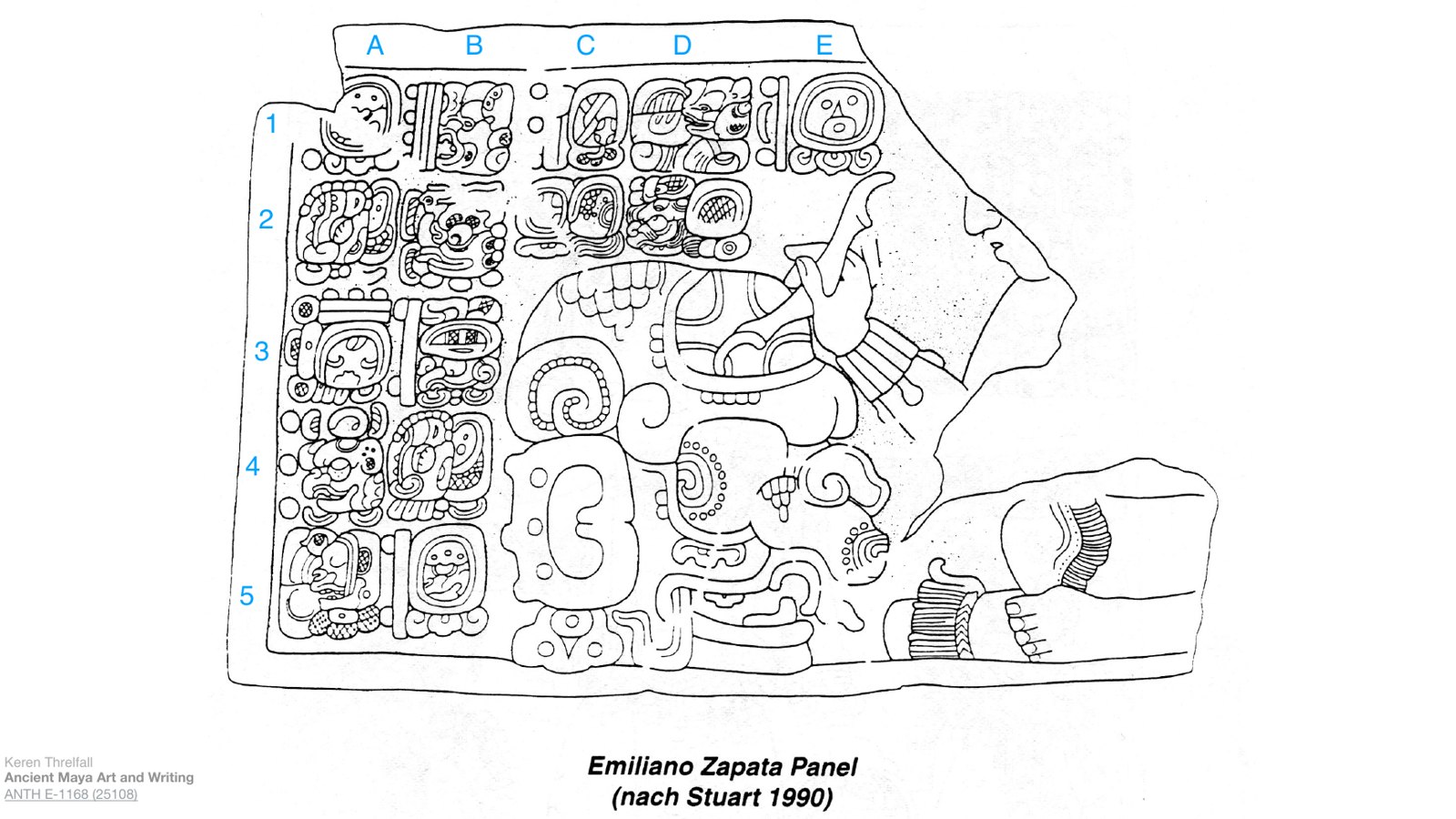
Fifteen glyphs survive on this panel, and between them they hold a whole life: a birth, a count of the days that followed it, a death, and the carving of the stone that remembers both. To their right a sculptor leans into his work, chisel raised against a great stone head. What follows is my reading of the panel, glyph block by glyph block, made as the final translation project for a semester spent learning to read Classic Maya.
About the Artifact
Although its provenience and its author remain nebulous, it is likely that this tablet came from the Palenque area, one of the many Maya cities fed by the riparian wealth of the Usumacinta River. David Stuart’s rendering of the tablet, published in 1990 in “A New Carved Panel from the Palenque Area,” has become the best-known image of what is now called the Emiliano Zapata Panel, and its dating most likely places it within the Late Classic period.1 The name comes not from any association with the Mexican campesino revolutionary, but rather from the panel’s current residence: a museum in the town that anachronistically bears the twentieth-century hero’s name, in the state of Tabasco, Mexico.2
The large image to the right of the tablet’s fifteen visible glyphs depicts a carver at work on a portion of a zoomorphic limestone head. A large k’an sign on the forehead tells us that the stone (tuun) is “yellow,” since limestone was referred to as “yellow stone”; Reading Maya Art notes the k’an sign in the forehead of a personified stone.3 (Within the Maya cosmovision, each cardinal direction was also represented by a color, and there may be some significance to this here, as well, where yellow is the color of the south.) The carved head also bears the markings for tuun, or stone, and on the left side of its silhouette the artist has given it a spondylus shell earring. It is a carving of a carving being carved — a sculptor’s portrait of his own profession, and one of the few places in Maya art where the making of a monument is itself the monument’s subject.4
Reading the Glyphs
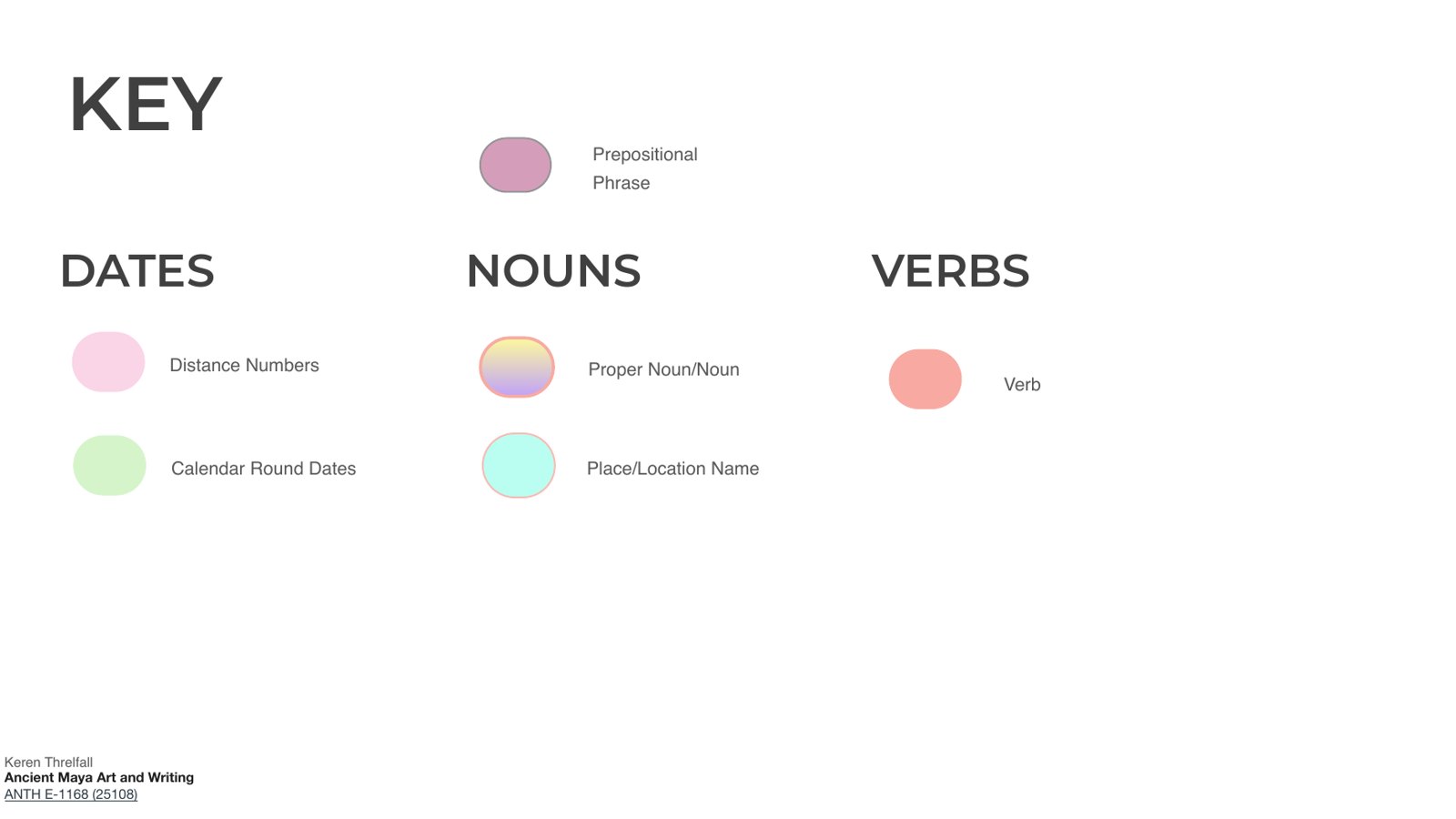
Classic Maya texts are read in paired columns, left to right and top to bottom, and the first thing to look for is the date, because the verb will nearly always follow it. I color-coded each glyph block by the work it does in the sentence: Calendar Round dates, Distance Numbers, verbs, proper nouns, nouns, and the one prepositional phrase. Transcriptions are given with LOGOGRAMS in capitals and syllabic signs in lower case; the transliteration into Classic Mayan and the English translation follow.
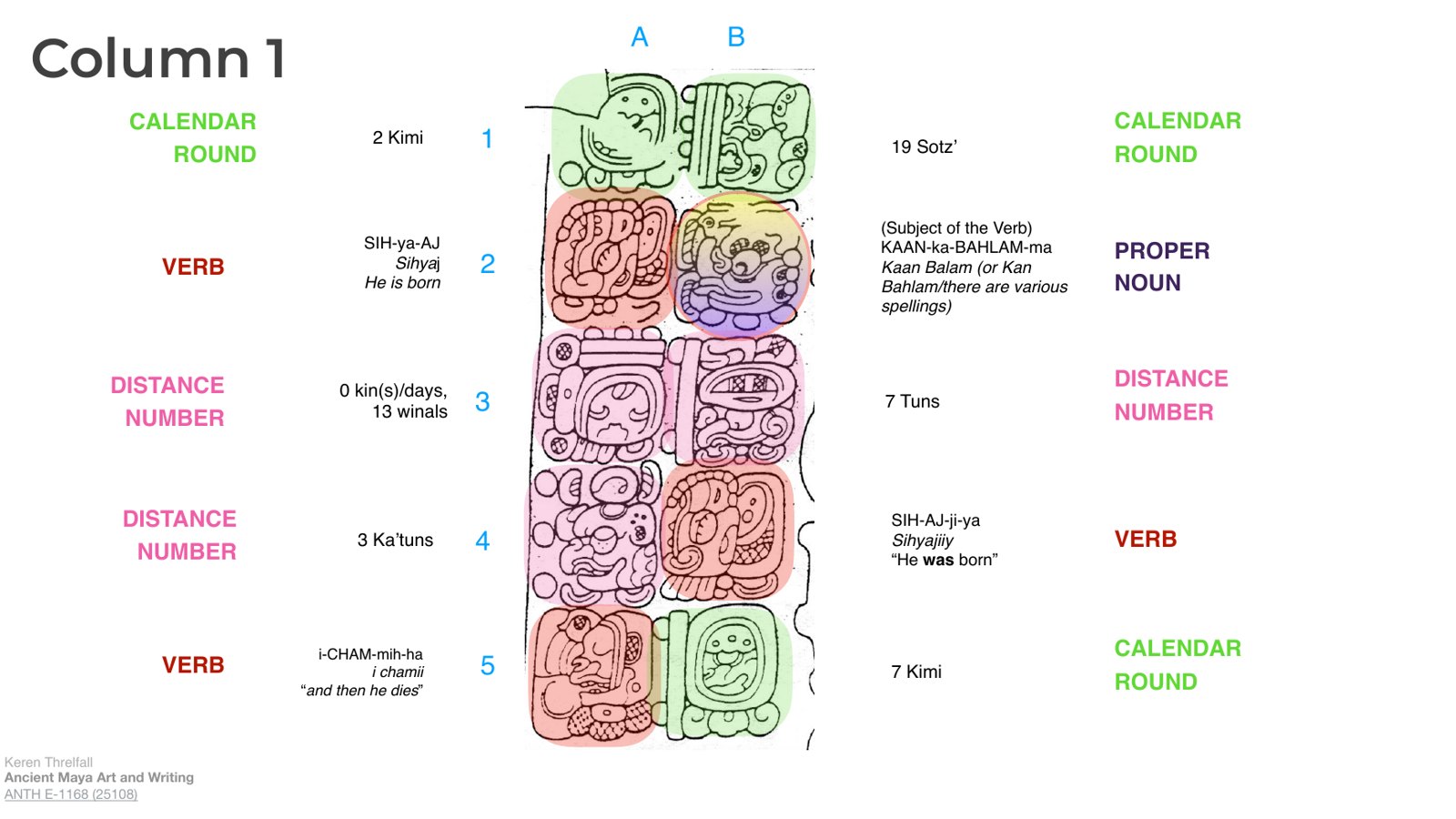
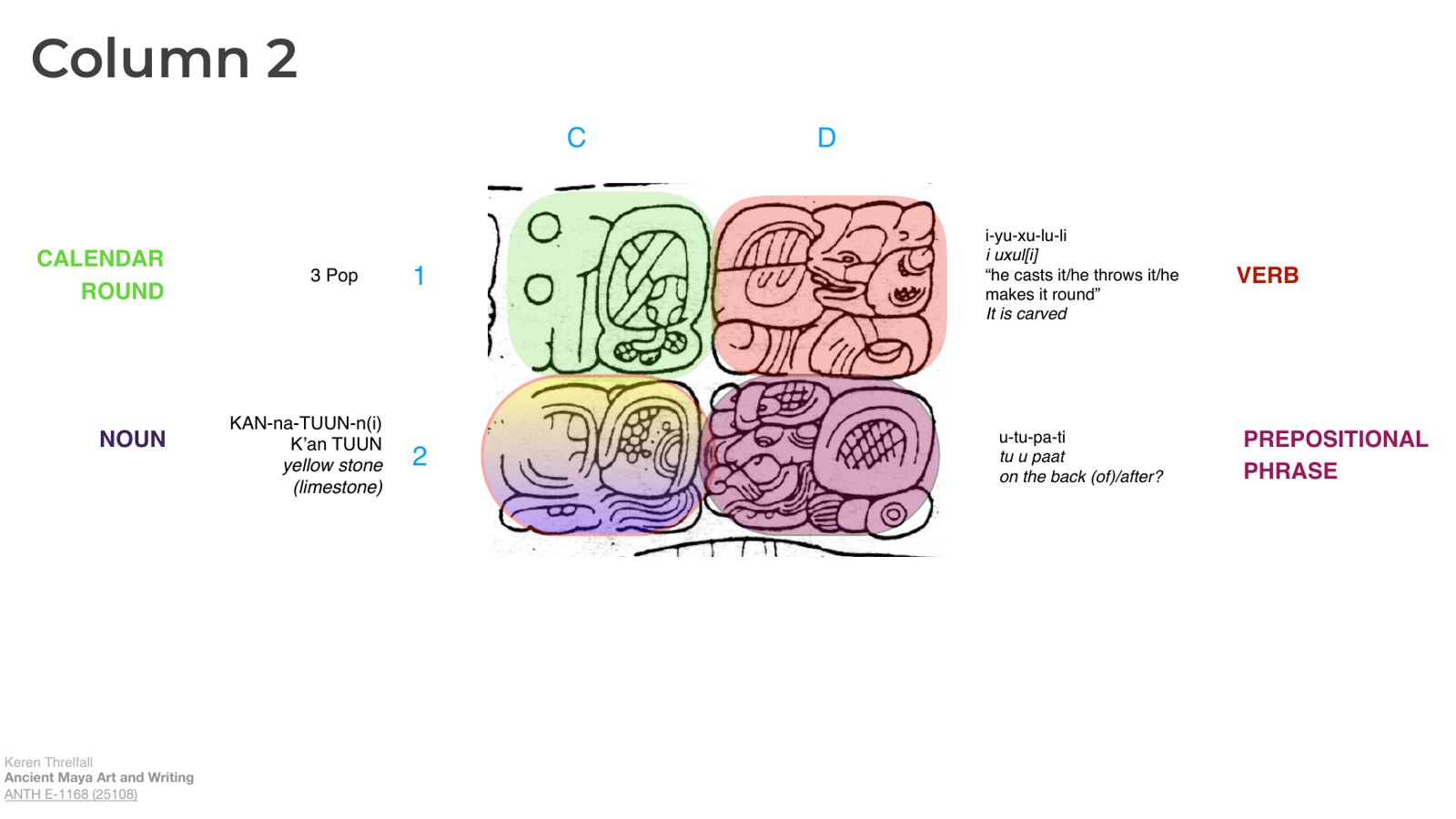
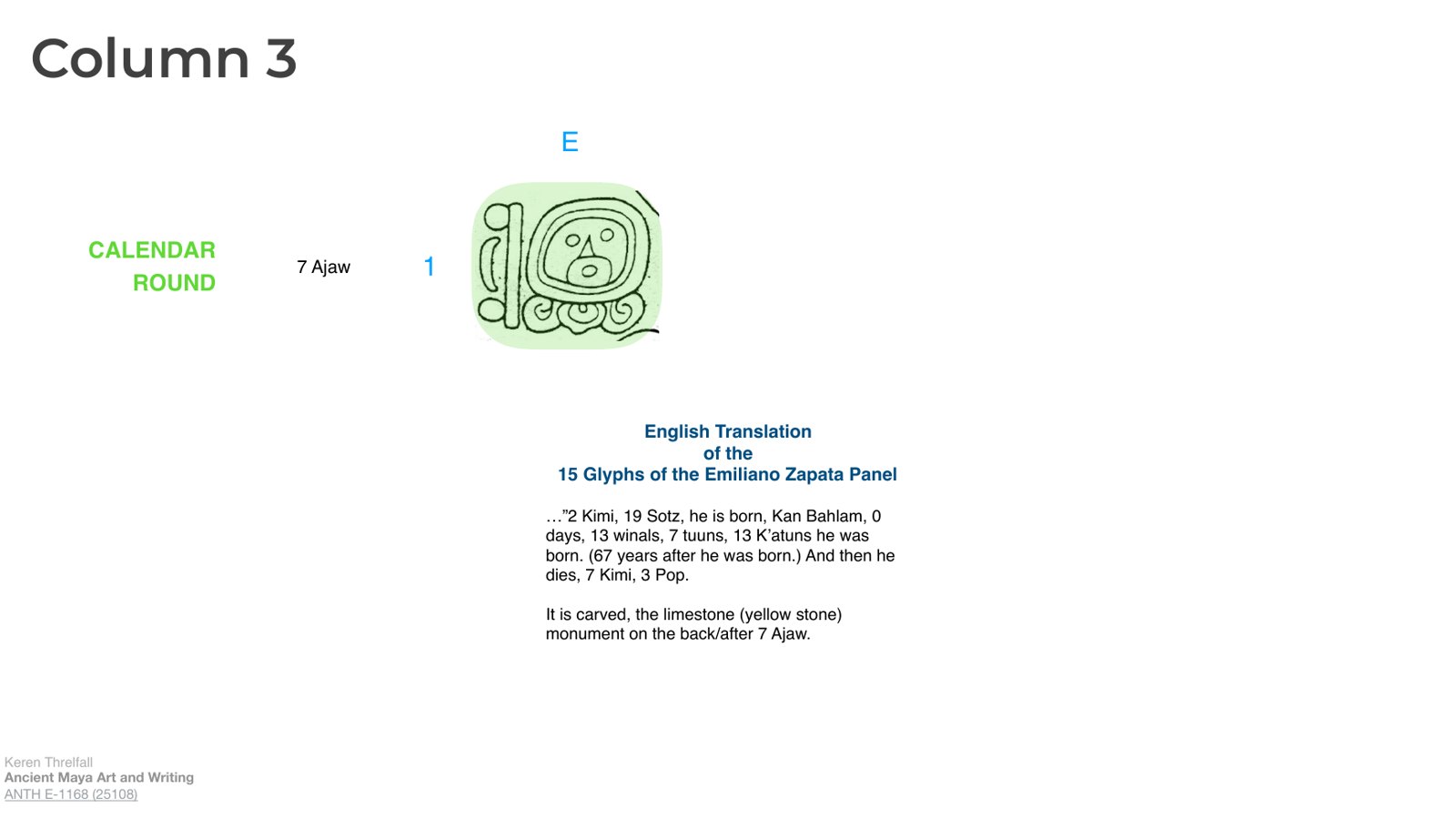
Taken block by block, the text runs as follows.
Columns A and B. The inscription opens with a Calendar Round date, 2 Kimi 19 Sotz’ (A1–B1). The verb follows at once: SIH-ya-AJ, sihyaj, “he is born” (A2), and then its subject, KAAN-ka-BAHLAM-ma, Kan Bahlam (B2), a name that appears in the literature in several spellings. Next comes a Distance Number, the count of time between one event and the next: 0 k’ins and 13 winals (A3), 7 tuuns (B3) and 3 k’atuns (A4). The scribe then looks back to the birth with the same verb in the past, SIH-AJ-ji-ya, sihyajiiy, “he was born” (B4), before moving the story forward: i-CHAM-mih-ha, i chamii, “and then he dies” (A5), on the day 7 Kimi (B5).
Columns C and D. The death date is completed by its month position, 3 Pop (C1). Then the text turns from the man to the monument. i-yu-xu-lu-li, i uxul[i] (D1), is the verb for carving: “it is carved.” What is carved is the KAN-na-TUUN-n(i), k’an tuun (C2), the “yellow stone,” which is to say the limestone itself. u-tu-pa-ti, tu u paat (D2), is a prepositional phrase, “on the back of,” which in a count of days can also be read as “after.”
Column E. One block remains before the break: 7 Ajaw (E1), a Calendar Round day, and the day to which the carving is tied.
The Translation
… On 2 Kimi 19 Sotz’ he is born, Kan Bahlam. Zero days, thirteen winals, seven tuuns and three k’atuns after he was born — and then he dies, on 7 Kimi 3 Pop.
It is carved, the yellow stone, after 7 Ajaw.
Three k’atuns, seven tuuns and thirteen winals come to a little under sixty-seven years.5 A whole life is held in a single Distance Number, and it is the grammar that I find most moving: the birth and the death are written with the name of the man, and the carving is written with no name at all. It is carved. Whoever raised the chisel on the right side of this panel signed the stone only with a picture of his hands.
Notes
1. David Stuart, “A New Carved Panel from the Palenque Area,” Research Reports on Ancient Maya Writing 32 (Center for Maya Research, 1990): 9–14.
2. Nikolai Grube, “Cover: A Hieroglyphic Panel in the Emiliano Zapata Museum, Tabasco,” Mexicon 16, no. 1 (1994): 1–2.
3. Andrea Stone and Marc Zender, Reading Maya Art: A Hieroglyphic Guide to Ancient Maya Painting and Sculpture (Thames and Hudson, 2011), 126.
4. Adam Herring, “Sculptural Representation and Self-Reference in a Carved Maya Panel from the Region of Tabasco, Mexico,” RES: Anthropology and Aesthetics, no. 33 (1998): 102–14.
5. A k’in is one day, a winal twenty days, a tuun 360 days and a k’atun 7,200 days. The count is therefore 21,600 + 2,520 + 260 = 24,380 days, or about 66.7 solar years.
Bibliography
Coe, Michael D., and Mark Van Stone. Reading the Maya Glyphs. 2nd ed. Thames and Hudson, 2005.
Grube, Nikolai. “Cover: A Hieroglyphic Panel in the Emiliano Zapata Museum, Tabasco.” Mexicon 16, no. 1 (1994): 1–2.
Herring, Adam. “Sculptural Representation and Self-Reference in a Carved Maya Panel from the Region of Tabasco, Mexico.” RES: Anthropology and Aesthetics, no. 33 (1998): 102–14.
Stone, Andrea, and Marc Zender. Reading Maya Art: A Hieroglyphic Guide to Ancient Maya Painting and Sculpture. Thames and Hudson, 2011.
Stuart, David. “A New Carved Panel from the Palenque Area.” Research Reports on Ancient Maya Writing 32 (1990): 9–14. Center for Maya Research.
Write to the author Responses come to Keren privately by email.
Harvard Extension School, May 2020. Revised, 2026.
© Keren Threlfall. To reprint or use this work, write to keren@kerenthrelfall.com.
How to cite this pieceThrelfall, Keren. “The Emiliano Zapata Panel: A Translation of Fifteen Glyphs from a Late Classic Maya Carving.” kerenthrelfall.com, May 2020. https://kerenthrelfall.com/writing/the-emiliano-zapata-panel