Writing · Reporting
For Deported U.S. Veterans, A Flag-Draped Casket Is the Only Way Home
By Keren ThrelfallJan 18, 202515 min read
The only legal way for Oscar Balladares to return to the United States is in a body bag.
As an honorably discharged Army veteran, he is entitled to have his body returned in a flag-draped casket and be buried with a military headstone beneath U.S. soil.
Brought by his mother to the United States from Nicaragua at age two, he grew up considering the USA home. Balladares enlisted in the Army after high school. He served four years, including two tours to Bosnia.
Soon after returning to civilian life in New Mexico, Balladares was arrested and charged with child abuse, an accusation he denies.
After serving his prison sentence, immigration authorities deported him to Nicaragua in June 2020.
Balladares is one of many U.S. veterans who enlisted with the expectation of receiving citizenship, but were deported following criminal or misdemeanor charges.
Now, they are trying to get back to the United States.
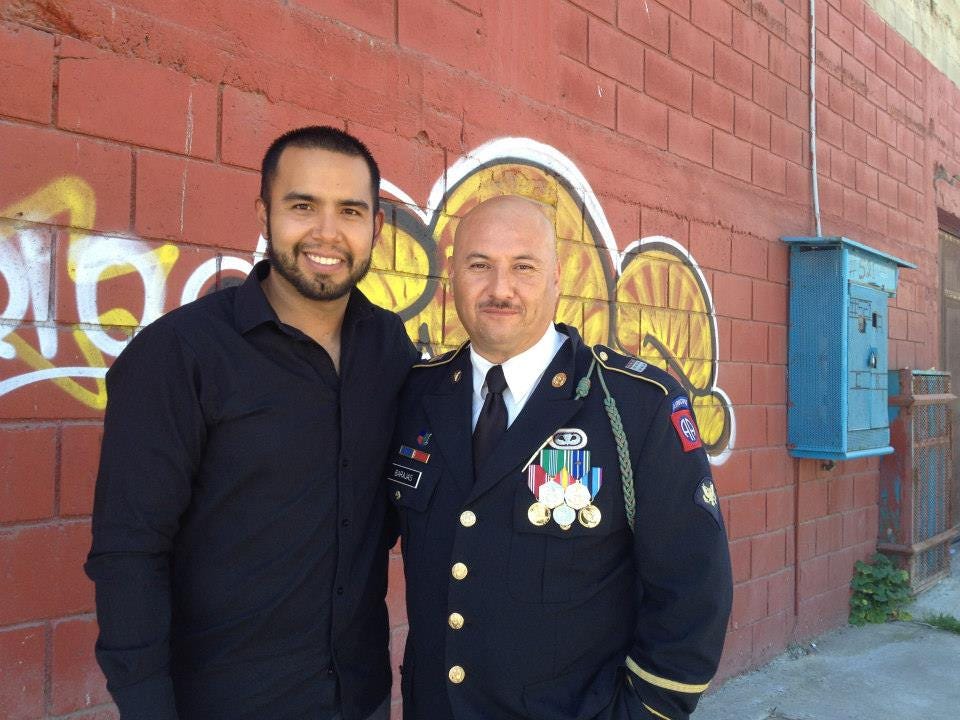
Roughly 65,000 foreign-born individuals serve in the U.S. armed forces, making up a little over 8% of the military. According to Immigration Forum, the United States had 94,000 noncitizen military veterans in 2018.
Although citizenship is not automatic or fully guaranteed in exchange for service, noncitizen veterans state that it is often pitched as such by recruitment officers.
In 1996, Congress passed legislation that expanded the range of charges for which immigrants could be deported. The enforcement was retroactive, meaning any noncitizen found to have committed applicable crimes or misdemeanors before 1996 — including older veterans of the Vietnam and Korean wars — could be deported.
For noncitizen veterans, a misdemeanor or criminal charge results in a jail or prison sentence followed by requisite deportation, even for permanent residents.
When it went into effect in 1997, critics say the legislation eliminated due process from the majority of deportation cases.
Dr. Everard Meade is the Director of the Trans-Border Institute at the University of San Diego, and serves as an expert witness in immigration courts across the country, and is part of the advisory board of the American Bar Association’s Immigrant Justice Project.
“What happened is that immigration judges lost the discretion they previously had. That’s why we have almost no cases of veterans being deported before 1997. A judge could easily see a veteran’s military record, and take that into consideration.”
“If American citizens faced the same penalty, nearly 1 in 3 Americans would be deported. There are Senators and members of Congress who have had the same types misdemeanor and criminal charges for which these veterans are being deported,” said Meade.
Research has found that, for post-9/11 veterans, just one deployment “increases the likelihood of property and violent crime, arrest, gang membership, [and] trouble with police.” This finding suggests the increased struggle many veterans face in reintegrating into society after military life, all while the criminal justice system has increased charges and convictions.
Of note, veteran deportations can easily take place as a result of wrongful convictions or from taking a plea bargain or no contest plea, where 97% of all felony convictions are the result of plea negotiation and noncitizens are often unaware that doing so also leads to deportation.
The overlap of these trends has resulted in increased deportations for noncitizen veterans.
On July 3, 2002, then-President Bush issued an executive order to expedite citizenship proceedings for noncitizens who have served in the U.S. military since the September 11 terror attacks. Then, in 2017, a Trump administration policy restricted previous eligibility offered by the Bush-era naturalization bill, resulting in a spike in naturalization denials among active duty members and veterans.
Often leaving jobs, partners, children, and entire families behind, many deported veterans have spent more years in the United States than in their countries of origin.
According to a report by the U.S. Government Accountability Office, the exact number of veterans who have been deported is unknown because U.S. Immigration and Customs Enforcement (ICE) does not consistently identify and track noncitizen veterans, nor does ICE always pursue due process when a deportee is identified as a veteran.
ICE did not respond to a request for comment.
“My Recruiter Told Me I’d Be Granted Citizenship for Serving”
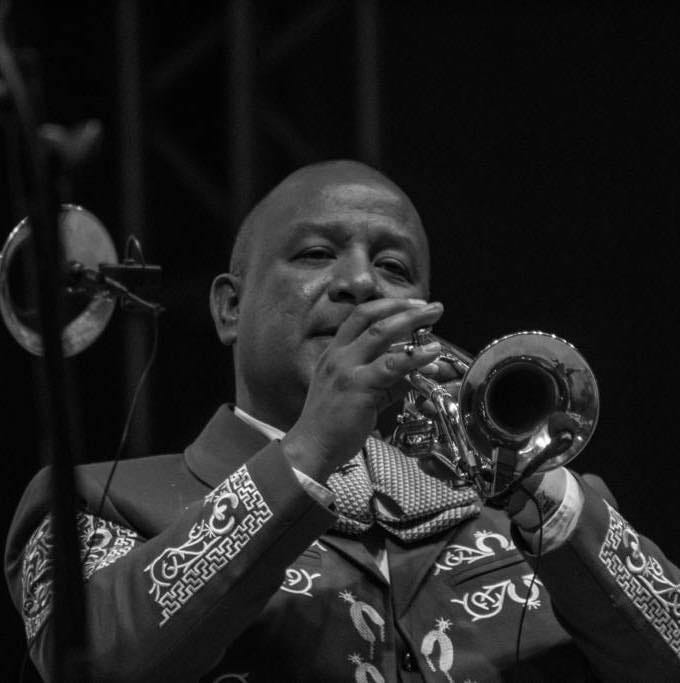
Ricardo Munoz was eight years old when his parents moved the family from Mexico to Indiana. He was one of only two Hispanic children in his public school near Indianapolis. Munoz quickly assimilated into an all-American childhood, losing his familiarity with Spanish along the way.
In 1995, Munoz was granted permanent residency. Upon finishing high school, his love for playing the trumpet led him to enroll as a music major at Indianapolis University.
When Munoz joined his father working on a farm during summer break, he saw how much his father suffered working long hours for meager pay, and realized his parents needed greater financial support than his academic path could provide. He also felt a strong sense of patriotism, and wanted to serve the country that had shaped his identity.
So in 1996, Munoz dropped out of university and enlisted in the Army instead.
“My recruiter wanted to sign me up as quickly as possible, and told me that I’d be granted citizenship for serving,” Munoz said.
“It’s ironic that they used that line all those years ago, because that wasn’t even my primary reason for joining. I wanted to serve out of love for my country, and to help my parents,” Munoz said.
Two days before Munoz’s unit deployed to Saudi Arabia, he received a letter notifying him that his naturalization ceremony was scheduled to take place in several weeks.
When the date arrived to take his oath for citizenship, Munoz was in Saudi Arabia, serving his Oath of Enlistment. On the same day he was under threat of chemical attack in the Arabian desert, Munoz’s naturalization paperwork expired in the country for which he was risking his life.
Several years after receiving an honorable discharge, Munoz was convicted of transporting marijuana on behalf of his brother and sentenced to eighteen months in prison. It was his first and only criminal offense — and an act that is no longer criminalized in many states.
After being released early for good behavior, an ICE van was waiting outside the doors when Munoz finished his commuted sentence. ICE deported him to Mexico the next day, where the van door was opened just over the Mexican side of the El Paso — Ciudad Juarez border. Munoz had no money and no phone.
He was disoriented without the ability to speak Spanish and without the Mexican matrícula consular ID needed to qualify for work in Mexico. Munoz found himself in an unfamiliar place, just as Ciudad Juarez was at its height as “the murder capital of the world.”
Munoz was able to join a mariachi band within a week of his deportation, something he said he quickly realized was not an option for many deported veterans who had simply been released over the border without options or resources.
“My trumpet saved me from violence,” said Munoz.
“I Believe I Have Earned My Right to Stay”
After his honorable discharge, Oscar Balladares settled in New Mexico and started a family with Wendy Puente, where their son, Amari, was born.
Occasionally, Balladares noticed that his left leg would give out while walking. It was something that troubled him since his first deployment, yet he did not become aware that it could be classified as a service connection disability until the year prior to his deportation.
When Amari was four months old, Balladares had a work shift that started later than normal, and decided to spend the extra time with his son.
He recalls that day in detail, telling how his infant son and life-as-he-knew-it came crashing down in an instant. Balladares remembers carrying his son down the stairs, when his left leg gave out — and both he and his son fell down a full flight of stairs.
Balladares next memory is of the entire family heading to the ER with Amari. He recalls looking on while the doctor ran additional X-Rays, then said he watched him scribble in his physician’s notes, “possible non-accidental trauma.”
Within the hour, a Crimes Against Children unit had arrived, and Balladares noticed they were speaking with everyone but him. When police arrived, they asked Balladares and his wife, Puente, to come to the station for further questioning.
“Of course I said yes. I was terrified. My son had just been injured, and I had taken him to the hospital. Next thing I knew, they were threatening my wife to take her children away if she didn’t provide evidence on me. But there wasn’t any, and eventually they let her go,” said Balladares.
“Then they interrogated me, and kept screaming in my face. Eventually, I think the shock set in, and I didn’t know what to say anymore. All I could say was ‘I don’t know.’ They let me go home, but I was told they would be filing charges.”
“A few days later, I was outside my home and suddenly saw shadows behind me. The police had come. I fought my case while being held for 13 months. When I was released on bond, I was able to go home until my sentencing,” said Balladares.
Balladares’ mother was able to find him an attorney, and together they fronted a $28,000 fee. But instead of fighting for his innocence, Balladares stated that his attorney told him his best option was taking a six to twelve year plea deal, rather than risk a potentially much harsher sentence. Having paid already, he complied.
“I didn’t know I had any other options at the time. I didn’t realize accepting a plea deal would lead to my deportation,” Balladares said.
“I also didn’t realize I had PTSD from the military, or that I could have claimed my service injuries as disabilities. I did know I had been a permanent resident for around thirty years, so I didn’t think twice that my status might be an issue.”
Balladares recalled telling his caseworker, “I fought for this country. There’s got to be something you can do!”
Instead, an ICE van was waiting for Balladares outside the prison doors.
“It was a horrible time, because it was just as the pandemic was getting bad. They weren’t even processing deportations like they normally do. ICE took us to El Paso, and then somewhere else. It took a little while of waiting in pretty bad conditions, but they finally put me on a plane to Nicaragua in June 2020,” said Balladares.
“It had been forty-two years since my mother fled Nicaragua with me. I was two. I had no memories of that place.”
Four months after his 2020 deportation to Nicaragua, Central American borders reopened and Balladares traveled to Torreón, Coahuila in Mexico, where his wife’s extended family owns a large hacienda. Several months later, his wife and 6 children joined him. Amari is now 11, in excellent health.
“I’m glad my wife had family here, but Mexico is so foreign to me. The U.S. is really my only home,” said Balladares.
The leg that gave out while Balladares carried infant Amari was eventually classified as a service connection disability, and he now receives disability pay from Veterans Affairs.
Balladares later learned that during a brief stay post-discharge with his mother in Miami, she had finished filing his naturalization papers to surprise him. But by the time the paperwork for a naturalization hearing was sent back to the address, Balladares and his mother had already moved to new addresses.
“My citizenship application was deemed abandoned by immigration services,” said Balladares
Balladares stated that he never saw the papers after they were completed, and that it was not until his deportation orders were served that he learned about his mother’s previous efforts to submit the paperwork.
“Can you please help? I fought for my country and believe I have earned my right to stay,” Balladares wrote from his Facebook account to the FB page of Governor, Michelle Lujan Grisham (D-NM).
The Bunker: A Brotherhood for Men Without a Country

Just past Tijuana Technical Institute on the corner next to a tire shop, a large American flag hangs on the doorway of The Deported Veterans Support House (DVSH). DVSH was founded by Hector Barajas-Varela, honorably discharged in 2001 — with the Army Commendation and Humanitarian Service Medals — then deported in 2004.
Today, the small support group that Barajas started in 2013 has expanded into what is better known among deported veterans as “The Bunker.”
The Bunker provides legal resources, temporary housing, food and supplies, and support to deported veterans. It relies primarily on donations, and has even expanded to open a second location in Juarez. Most importantly, it has provided a sense of brotherhood.
As a result of advocacy groups and in conjunction with the US DHS and Office of Veterans Affairs, the VA was able to coordinate a third way — albeit only for one day — for deported veterans to return to the U.S: permission to step across the border to attend Covid-19 vaccination clinics, events which took place in both El Paso, Texas and the San Ysidro Port of entry in California.
Several veterans who showed up for the clinic traveled from distant locations, including Balladares, who made the eight-hour drive from Torreón, Coahila to El Paso. Another veteran was noted as making a drive of over twenty hours to the San Ysidro clinic. These first-of-a-kind vaccine clinics for deported veterans were important not just because of access to the vaccination, but also because of the camaraderie it offered deported veterans through a shared experience.
For Balladares, it provided the opportunity to introduce his wife and sons to the deported veteran community. The organization, Repatriate Our Patriots was present at the El Paso clinic, and later posted a video interview with Balladares and his sons on their Instagram account. There, Amari tearfully shared how challenging his father’s exile has been.
“I don’t like the thing where he can’t come home,” Amari sobbed, as he walked away from the camera’s view.
Potential Improvement for Noncitizen Veterans through Policy Change
Of the 2020 Presidential candidates, only Senator Elizabeth Warren (D-MA) made a public statement on policy change involving the deportation of veterans, when she stated in Perry, Iowa in 2019, “My promise to you, is when I’m President of the United States, no military veteran will ever be deported.” Her promise was made to all U.S. Veterans, but was particularly in response to an appeal by Vietnam veteran, Manuel Valenzuela, who was in the process of filming for the PBS documentary, American Exile, released on November 16, 2021.
Although Senator Warren withdrew from the presidential race in March 2020, she has continued to support deported veterans, such as through her cosponsorship of the Veteran Deportation Prevention and Reform Act introduced by Representative Mark Takano (D-CA 41st District) and U.S. Senator Alex Padilla (D-CA), where the potential for traction has left many veterans hopeful.
The hopefulness many veterans claim to feel is also buoyed by the seeming support of the Biden administration. On July 2, 2021, the Secretary of Homeland Security, Alejandro N. Mayorkas, and Secretary of Veterans Affairs, Denis R. McDonough, jointly announced “a new initiative to support our Nation’s noncitizen service members, veterans, and the immediate family members of service members,” and announced the initiative on the DHS website.
In online groups for deported veterans, U.S. Senator Tammy Duckworth (D-IL), who lost her legs in service and has long advocated for better veteran services, is spoken of with highest praise. Several deported veterans credit her for their being able to receive disability pay in the last 1–2 years. Duckworth introduced a comprehensive bill package to better protect noncitizen veterans in 2021, which has more to do with providing all veterans what they were promised for serving — benefits, healthcare, and a pathway to citizenship.
Yet, until such bills garner widespread bipartisan support or proceed to further hearings, they still generate skepticism among those whose lives are most directly impacted by existing deportations. A veteran of the Iraq War who goes by the pseudonym of Skurvios Dogius, made a remark on these bills that reflects a latent distrust ubiquitous among noncitizen veterans, “So just a bill that has to go through more committees and recommendations? And what good is permanent residency if it’s still deportable?”
Current Repatriations Only Apply to Individual Cases
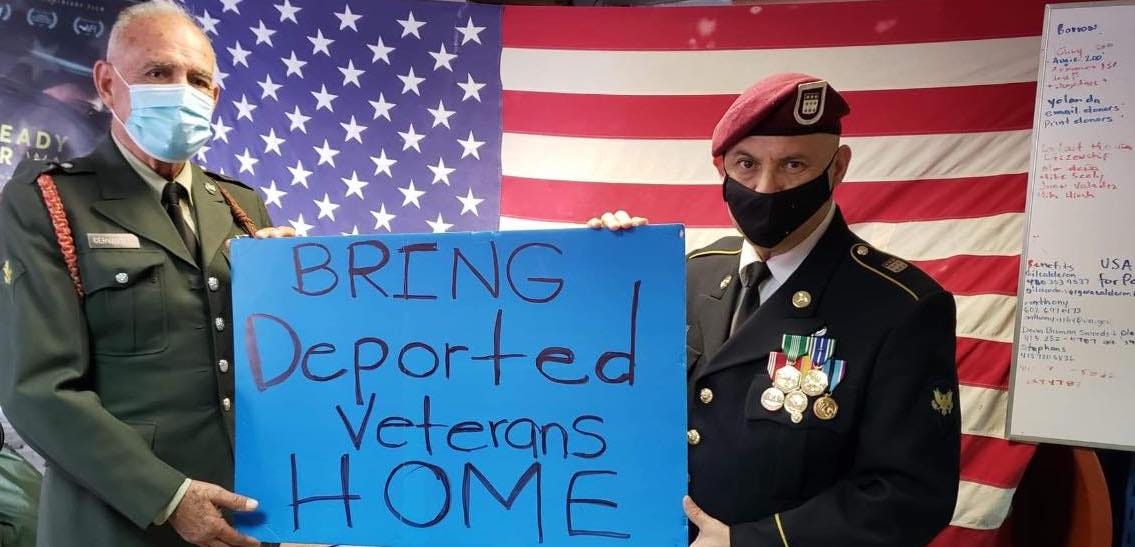
In 2018, fourteen years after his original deportation, Hector Barajas-Varela was able to show up for his naturalization ceremony, after former California Governor Jerry Brown (D) issued a pardon for the crime that led to his deportation. (He had pleaded guilty to a felony conviction of firing a gun into a vehicle.)
On December 21, 2017, deported Marine veteran Marco Chavez also received a pardon from Governor Jerry Brown, allowing him to return to the U.S. after a fifteen-year deportation. Chavez had been convicted for animal cruelty, a charge he denied. The pardon allowed him to become a permanent resident; but he is still hoping to receive full citizenship.
“People don’t even know that we are deporting veterans. I think most Americans assume that when somebody serves, they gain American citizenship. They don’t realize that we are actually deporting people who served honorably,” stated U.S. Senator Tammy Duckworth (D-IL) on her website.
Yet, these repatriations only represent individual cases and do not establish a precedent for broad reform for deported veterans.
Dr. Meade, the University of San Diego academic and expert witness in immigration courts, said it is challenging for deported veterans to receive a ruling that impacts other deported veterans because the cases are all so different, and currently the only legal way to address them is through an individual case basis.
“So many of them feel they were sold a bill of goods to join the military, yet are not eligible for the very Bill of Rights that they swore an oath to fight for,” said Meade.
“Don’t Wait to Honor Me When I’m Dead”
In November 2021, Ricardo Munoz’s mother — a US citizen — took her final breath in a Texas nursing home.
“I’m running into brick walls trying to get a temporary humanitarian visa to go bury her, and it’s the deepest feeling of despair not to have the basic human right to go bury one’s parents,” said Munoz. He was denied the same request when his father died, but is hopeful things might be different this time.
Only in death can Munoz reunite with his parents — to be buried beneath a shared US soil, and only in death can he be officially recognized as an American again.
“Don’t wait to honor me when I’m dead,” said Munoz as tears filled his eyes.
“I made a mistake that I deeply regret, and I served my time. I would still give my life in service to America. I’m American. But to not be able to enter the country to bury your loved ones…that is the perpetual punishment,” said Munoz.
(This article was written and based on facts, data, and details still true in December 2021; some details and immigration statuses may have since changed.)
Write to the author Responses come to Keren privately by email.
Originally published on Medium, Jan 18, 2025. Read it on Medium →
© Keren Threlfall. To reprint or use this work, write to keren@kerenthrelfall.com.
How to cite this pieceThrelfall, Keren. “For Deported U.S. Veterans, A Flag-Draped Casket Is the Only Way Home.” kerenthrelfall.com, Jan 18, 2025. https://kerenthrelfall.com/writing/deported-veterans-flag-draped-casket